Modern Shipbuilding H-Beam Fabrication: A Strategic Shift to High-Power Laser Technology
Published by: Chief Structural Engineer | Industry Insight | 2026
In the contemporary maritime industry, the paradigm of shipbuilding is evolving toward extreme modularity. As shipyards worldwide strive for "Smart Manufacturing," the fabrication of structural components like H-beams has moved beyond traditional rough cutting. The core challenge is no longer merely "parting" the metal, but managing thermal energy to prevent warpage in massive marine-grade steel structures.
I. The Evolution: From Thermal Burning to Precision Machining
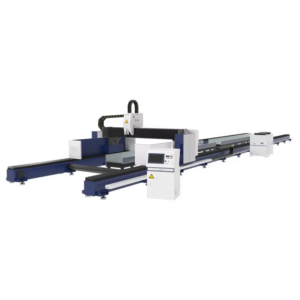
For decades, shipyards relied on Oxy-fuel and Plasma. However, the high heat input creates a "banana effect" in long H-beams, requiring expensive manual corrections. Today, the introduction of 20kW+ fiber laser systems has altered the shipyard floor. Unlike plasma, a laser delivers a coherent beam that melts metal with surgical precision, leaving the Heat Affected Zone (HAZ) virtually non-existent.
The Integration of Robotics
Modern ship designs require complex "saddle" cuts and bevels. This complexity is handled effortlessly by advanced 6-axis robotic arms. These systems execute 3D geometries in a single pass, replacing multi-step manual processes with a "Straight-to-Weld" workflow.
II. Quantitative Technology Comparison
| Metric | Oxy-fuel (Flame) | HD Plasma | Fiber Laser (20kW+) |
|---|---|---|---|
| Dimensional Accuracy | ±2.5mm (Low) | ±0.8mm (Medium) | ±0.15mm (High) |
| Heat Affected Zone (HAZ) | 3.0mm - 5.0mm | 1.0mm - 2.0mm | 0.1mm - 0.3mm |
| Secondary Processing | Heavy Grinding | Slag removal | None / Weld-Ready |

III. Digital Twin and Smart Production
One of the most significant advantages of laser technology is its digital compatibility. Through Digital Twin technology, CAD data is translated into cutting paths. This ensures that every beam cut in the shop is an exact replica of the virtual design, facilitating "first-time-right" assembly and significantly reducing the "Gap" variance during modular fit-up.
IV. Investment Analysis and ROI
While the initial expenditure for robotic laser H-beam lines is higher than plasma, shipyards typically see an ROI within 18–24 months. This is driven by a 70% reduction in manual grinding and a 40% improvement in welding speed due to perfect fit-up. The bridge between traditional craft and future-proof digital manufacturing is built on high-precision laser machining.