Maximizing Operational Efficiency through High-Speed Tube Laser Integration
The transition from traditional mechanical sawing and manual machining to advanced fiber laser processing represents a critical shift in metal fabrication. To achieve a rapid return on investment (ROI), fabricators must look beyond initial acquisition costs and focus on the technical throughput capabilities of the machine. A cost-effective tube laser cutting machine must balance dynamic performance with precision engineering to eliminate secondary processes and minimize material waste.
Dynamic Performance and Kinematic Stability
The productivity of a tube laser is fundamentally dictated by its dynamic performance, specifically the synchronization between the gantry’s linear acceleration and the rotational speed of the chucks. High-speed fiber laser oscillator technology requires a mechanical platform capable of rapid direction changes without compromising accuracy. Modern industrial systems utilize a bus CNC system, which facilitates high-speed data transmission and real-time synchronization between the laser source and the servo motors.
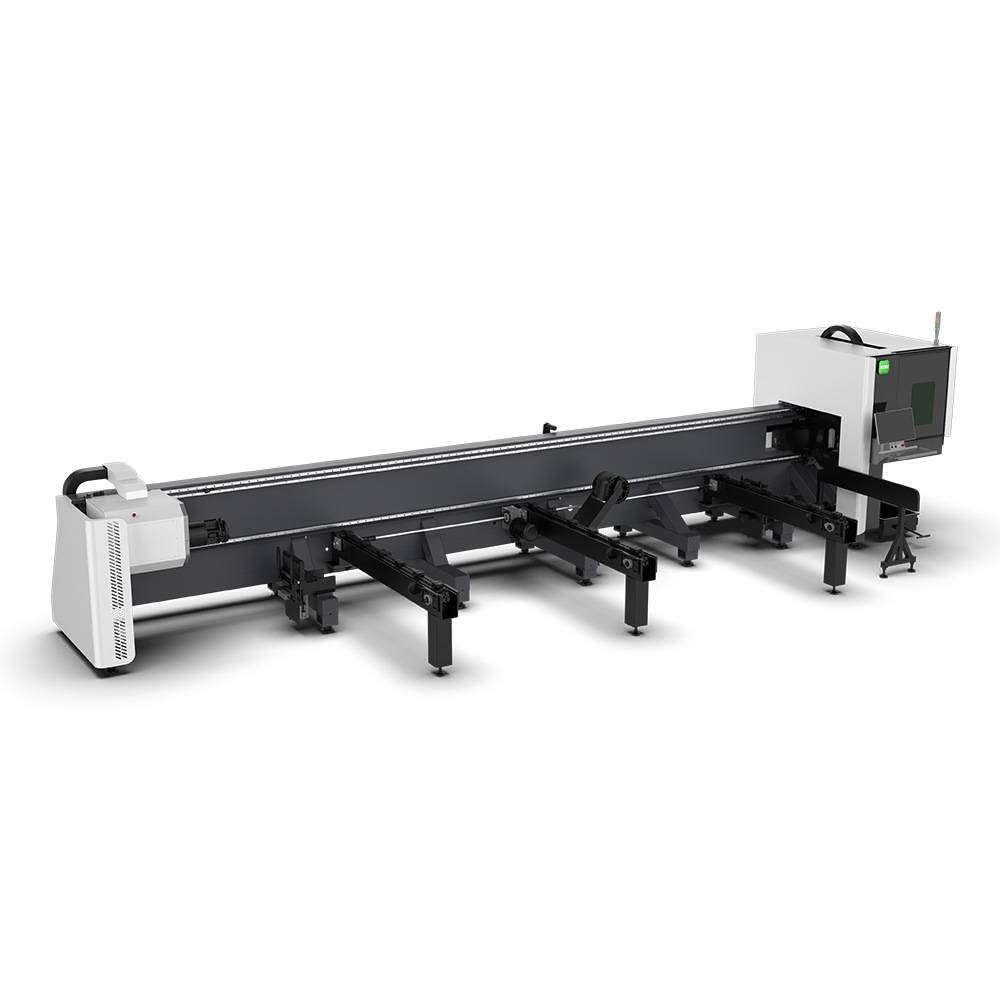
Acceleration rates exceeding 1.2G are essential for reducing non-cutting transit time. However, this acceleration must be supported by a high-rigidity, stress-relieved machine bed to dampen vibrations. When processing thin-walled tubing, the RPM of the pneumatic full-stroke chuck is a primary bottleneck. Contemporary systems achieve rotational speeds of up to 150 RPM, allowing for the rapid execution of complex geometries and interlocking joints. The use of a pneumatic full-stroke chuck is particularly advantageous as it eliminates the need for manual jaw adjustments across varying tube diameters, significantly reducing setup times during high-mix production runs.
Precision Engineering and Zero-Tailing Technology
Precision in tube laser cutting is not merely about the accuracy of the laser beam but the mechanical control of the workpiece. One of the most significant advancements in achieving a fast ROI is 3-chuck zero-tailing technology. In standard 2-chuck configurations, a significant portion of the tube—the “tail”—cannot be processed because it must remain clamped. A 3-chuck system allows for the physical shifting of the tube during the cutting process, enabling the machine to process the entire length of the material. This reduces scrap rates to near zero, providing immediate material cost savings that directly impact the bottom line.
Furthermore, precision engineering must account for the Heat Affected Zone (HAZ). Fiber laser resonators produce a highly concentrated beam that minimizes the thermal input into the material. This narrow HAZ ensures that the structural integrity of the tube remains intact and that the edges are clean enough for immediate welding. To maintain dimensional accuracy, the bus CNC system employs kerf compensation algorithms. These algorithms automatically adjust the laser path to account for the width of the material removed by the laser, ensuring that tabs and slots fit with interference-level precision, thereby eliminating the need for post-process grinding or deburring.
Material Adaptability and Resonator Efficiency
A cost-effective tube laser must demonstrate high versatility across different metallurgical profiles. The fiber laser resonator is the heart of this adaptability. When processing carbon steel, the use of oxygen as a cutting gas allows for high-speed piercing and clean cuts in thicker wall sections. For stainless steel, nitrogen is preferred to prevent oxidation, resulting in a bright, weld-ready edge.
Reflective materials, such as aluminum and copper, historically posed a challenge for laser systems due to back-reflection damaging the oscillator. Modern high-speed fiber laser oscillator units are designed with back-reflection protection, allowing for continuous processing of non-ferrous metals without the risk of hardware failure. The ability to switch between material types with minimal parameter adjustment is facilitated by integrated cutting databases within the CNC system. These databases optimize power, frequency, and gas pressure based on the specific material grade and wall thickness, ensuring peak performance regardless of the job requirements.
Automation and the ROI Equation
The most significant driver of ROI in tube laser cutting is the reduction of manual labor through an automated tube loading system. Manual loading of heavy tubes is not only a safety risk but a major source of machine downtime. An automated tube loading system can feed raw stock into the machine in a continuous cycle, allowing for “lights-out” operation during off-shifts. When combined with servo-driven support mechanisms that prevent tube sagging and vibration during rotation, the system maintains high precision even at maximum feed rates.
Software integration plays an equally vital role in operational efficiency. CNC nesting optimization tools allow engineers to maximize the number of parts per tube, further reducing material costs. Advanced nesting software can handle common-line cutting—where a single cut separates two parts—reducing the total cutting path and gas consumption.
By integrating a bus CNC system with automated peripherals, manufacturers can achieve a highly predictable production environment. The reduction in scrap through 3-chuck technology, the elimination of secondary cleaning processes due to minimal HAZ, and the high throughput of the high-speed fiber laser oscillator create a synergistic effect. This technical convergence ensures that the capital expenditure is offset by lower per-part costs and increased capacity, leading to a fast and sustainable return on investment in the competitive metal fabrication landscape.
Advanced Fiber Laser Tube Processing Technology
Our CNC Fiber Laser Tube Cutting systems revolutionize metal fabrication by integrating high-precision cutting, punching, and profiling into a single automated workflow. Designed for versatility, this technology handles a wide array of profiles including Round, Square, Rectangular, and Oval tubes, as well as complex L-shaped and U-shaped channels.
- Precision Punching: High-speed hole punching with micron-level accuracy, eliminating the need for mechanical drilling or die-stamping.
- Complex Profiling: Advanced 3D pathing allows for intricate interlocking joints and specialized notch cuts, ideal for structural frames.
- High Material Efficiency: Intelligent nesting software minimizes scrap, reducing raw material costs across large production runs.
- Clean Finish: Delivers oxide-free, burr-free edges that require zero secondary grinding before welding.

Seamlessly processing multiple profiles with consistent precision.
Global Delivery & Logistics



From our high-tech manufacturing facility directly to your global site. PCL WeldCut ensures secure packaging, professional handling, and reliable international logistics to safeguard your equipment throughout the entire journey.