Welcome to the PCL Group Blog
Latest Articles
Robotic Welding Cell with Laser Seam Tracking for for Pressure Vessels
This technical analysis examines the implementation of robotic MAG welding cells equipped with laser seam tracking for the production of pressure vessels. It details the transition from manual processes to automated systems, focusing on deposition rates, the elimination of weld defects through real-time path correction, and the rigorous maintenance schedules required to ensure 99% uptime. Furthermore, the document provides a comprehensive labor ROI breakdown, illustrating how shifting from high-cost manual certified welders to robotic operators significantly reduces the cost-per-vessel while enhancing structural integrity.
Robotic Welding Cell with Laser Seam Tracking for for Pressure Vessels
This technical analysis examines the integration of robotic MAG welding cells equipped with laser seam tracking for the production of pressure vessels. It details the transition from manual heavy-gauge welding to automated systems, focusing on deposition rates, maintenance protocols for wire-feed consistency, and the multi-variable labor ROI associated with replacing high-skill manual labor with robotic operators.
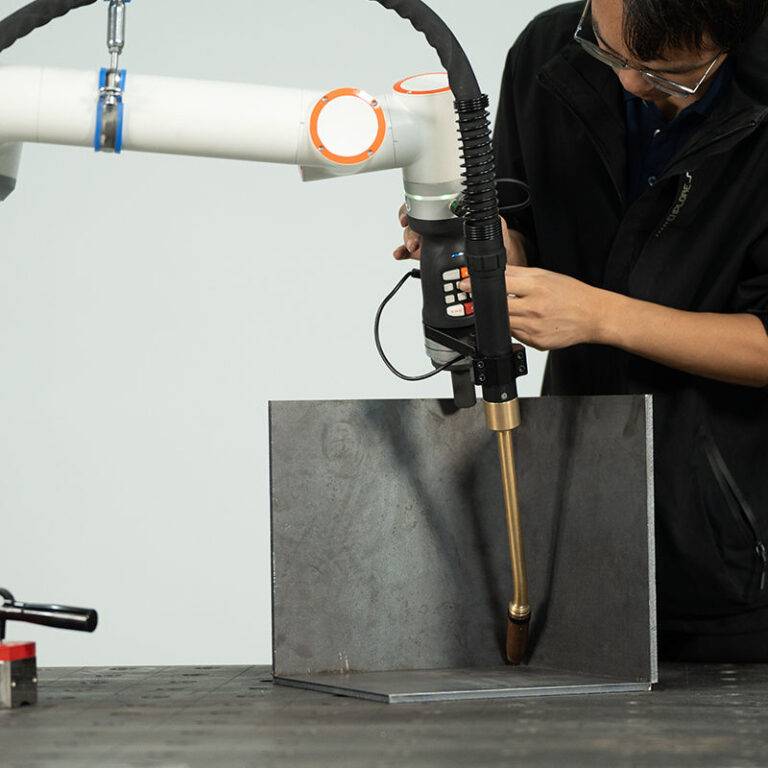
Engineering Review: 1500W 6-Axis Collaborative Welder – Milan, Italy
Milan site report: 1500W Cobot integrated. 6-Axis mobility is solving our tight radii issues in sheet metal. Automated pathing now beating manual rates.
Robotic Welding Cell with Laser Seam Tracking for for Pressure Vessels
This technical analysis examines the implementation of a Robotic Welding Cell integrated with Laser Seam Tracking for the production of high-pressure vessels. By shifting from manual Gas Metal Arc Welding (GMAW/MAG) to an automated 6-axis system, manufacturers can achieve superior penetration consistency, reduce radiographic testing (RT) failures, and optimize labor ROI. The article details the technical parameters of MAG welding in an automated environment, the preventive maintenance schedules required for system longevity, and the financial justification for capital expenditure based on throughput increases and reduced rework.