DYNAMIC KINEMATICS AND HIGH-SPEED OSCILLATOR INTEGRATION
Modern industrial tube processing demands a synthesis of structural rigidity and extreme kinetic agility. The core of a high-performance laser tube cutting machine lies in its gantry stability and the responsiveness of its motion control system. By utilizing a high-speed fiber laser oscillator integrated with a bus CNC system, manufacturers achieve a seamless communication loop between the cutting head and the drive motors. This architectural synergy allows for acceleration rates frequently exceeding 1.2G to 1.5G, which is critical when navigating complex geometries or tight-radius corners in square or rectangular profiles.
The mechanical stability is anchored by a heavy-duty, stress-relieved machine bed, often fabricated from high-tensile steel plates or cast iron components. This foundation mitigates harmonic vibrations that occur during high-speed direction changes. Furthermore, the pneumatic full-stroke chuck system is engineered for rapid rotation, often reaching speeds up to 120-150 RPM. Unlike manual or semi-automatic chucks, the pneumatic full-stroke design eliminates the need for manual adjustment when switching between varying tube diameters, significantly reducing downtime and ensuring the center of rotation remains consistent. This dynamic performance is essential for maintaining the focal point accuracy required for the fiber laser resonator to penetrate high-density materials with millimetric precision.
PRECISION ENGINEERING AND ZERO-TAILING TECHNOLOGY
In the realm of high-precision fabrication, material waste and edge quality are the primary metrics of efficiency. Precision engineering in laser tube cutting is defined by the implementation of kerf compensation and the management of the heat-affected zone (HAZ). Kerf compensation is handled via the bus CNC system, which calculates the width of the material removed by the laser beam—typically ranging from 0.1mm to 0.3mm—and adjusts the cutting path in real-time to ensure dimensional accuracy. Minimizing the HAZ is equally vital, particularly for thin-walled stainless steel tubes where excessive heat input can lead to micro-cracking or discoloration. By modulating the pulse frequency and peak power of the high-speed fiber laser oscillator, operators can achieve a cold-cutting effect that preserves the metallurgical integrity of the workpiece.
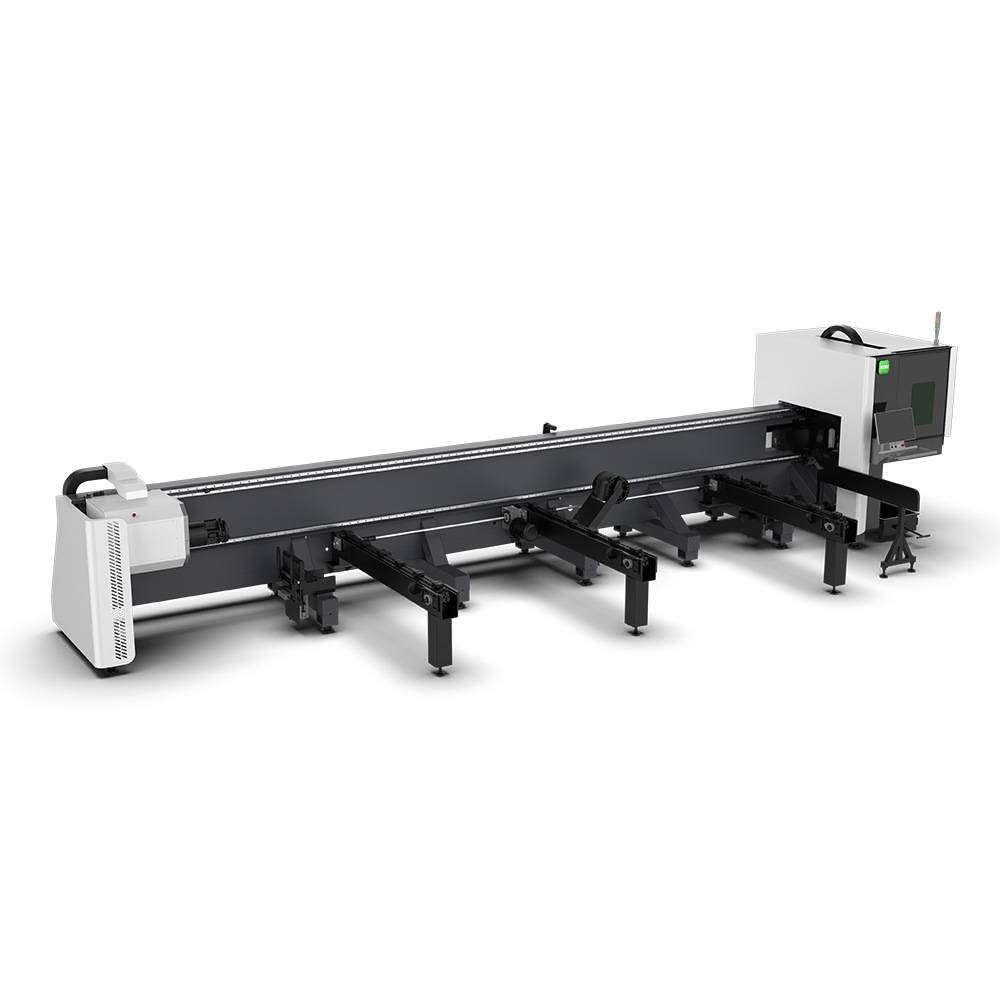
A significant advancement in reducing material overhead is the 3-chuck zero-tailing technology. Traditional two-chuck systems often leave a substantial “tailing” or remnant at the end of the tube, as the final section cannot be supported during the cut. A three-chuck configuration utilizes a middle chuck that provides continuous support while the rear and front chucks reposition. This allows for the cutting head to process material directly adjacent to the chuck face, reducing the final remnant to near zero. This capability not only maximizes the utilization of every linear meter of raw material but also provides additional servo-driven support for long-form tubes, preventing sagging and ensuring that the longitudinal axis remains perfectly aligned with the laser focal point throughout the entire cutting cycle.
MATERIAL ADAPTABILITY FOR STAINLESS STEEL AND REFLECTIVE ALLOYS
The versatility of a fiber laser resonator is most evident when transitioning between ferrous and non-ferrous metals. Stainless steel, characterized by its high chromium content and thermal resistance, requires a specific gas-assisted approach. Typically, high-pressure nitrogen is utilized as the auxiliary gas to expel the molten metal through the kerf, preventing oxidation and resulting in a mirror-like finish on the cut edge. The CNC system must precisely regulate the gas pressure and nozzle height to maintain a stable plasma plume, ensuring the consistency of the cut across varying wall thicknesses.
When processing reflective materials such as aluminum, brass, or copper, the technical challenges shift toward managing back-reflection. Aluminum’s high thermal conductivity and low absorption rate of infrared light can potentially damage the optical components of the laser source. To counteract this, modern machines employ high-speed fiber laser oscillators equipped with back-reflection isolators and specific wavelength modulations. The cutting parameters for aluminum often involve higher frequency settings and specialized nozzle geometries to maintain a clean severance without dross accumulation. Carbon steel, by contrast, is typically processed using oxygen-assisted cutting, leveraging an exothermic reaction to increase cutting speeds on thicker sections. The ability of the bus CNC system to store and recall these discrete parameter libraries allows for rapid transitions between materials, ensuring the machine remains a multi-purpose tool in high-mix, low-volume production environments.
INTEGRATED AUTOMATION AND ROI OPTIMIZATION
The transition from a standalone cutting unit to a fully autonomous production cell is facilitated by an automated tube loading system. This peripheral hardware manages the staging, alignment, and feeding of raw stock into the machine, effectively eliminating the labor-intensive process of manual loading. When combined with servo-driven support structures that automatically adjust to the tube profile, the system ensures that even the most delicate thin-walled aluminum tubes are handled without surface marring or deformation. This level of automation directly impacts Return on Investment (ROI) by increasing the “beam-on” time, allowing the machine to operate through breaks or across multiple shifts with minimal human intervention.
Software-side efficiency is driven by CNC nesting optimization. Sophisticated nesting algorithms analyze the production queue to arrange various parts on a single length of tubing, minimizing scrap through common-line cutting and intelligent part-sorting. This optimization is not merely about geometry; it also factors in the structural stability of the tube during the cutting process, ensuring that the most rigid sections are cut first to prevent vibration-induced inaccuracies. By integrating the automated tube loading system with advanced nesting software, manufacturers can achieve a highly predictable and repeatable workflow. This reduces the cost-per-part through lower material waste, reduced secondary deburring operations due to superior edge quality, and a significant reduction in overall cycle times. The combination of high-speed kinematics, precision chucking, and automated logistics transforms the laser tube cutting machine into a cornerstone of modern industrial manufacturing.
Advanced Fiber Laser Tube Processing Technology
Our CNC Fiber Laser Tube Cutting systems revolutionize metal fabrication by integrating high-precision cutting, punching, and profiling into a single automated workflow. Designed for versatility, this technology handles a wide array of profiles including Round, Square, Rectangular, and Oval tubes, as well as complex L-shaped and U-shaped channels.
- Precision Punching: High-speed hole punching with micron-level accuracy, eliminating the need for mechanical drilling or die-stamping.
- Complex Profiling: Advanced 3D pathing allows for intricate interlocking joints and specialized notch cuts, ideal for structural frames.
- High Material Efficiency: Intelligent nesting software minimizes scrap, reducing raw material costs across large production runs.
- Clean Finish: Delivers oxide-free, burr-free edges that require zero secondary grinding before welding.

Seamlessly processing multiple profiles with consistent precision.
Global Delivery & Logistics



From our high-tech manufacturing facility directly to your global site. PCL WeldCut ensures secure packaging, professional handling, and reliable international logistics to safeguard your equipment throughout the entire journey.
