Maximizing Throughput with Advanced Kinematic Control
The core of modern CNC tube laser cutting lies in the synchronization of high-speed fiber laser oscillators and the kinematic chain of the machine bed. Industrial-grade tube cutters must maintain exceptional gantry stability to counteract the centrifugal forces generated during high-speed rotation. When processing rectangular or asymmetrical profiles, the acceleration requirements often exceed 1.2G to maintain constant cutting speeds at corners. This is achieved through a low-inertia aluminum crossbeam and a reinforced bed frame that has undergone stress-relief annealing.
The dynamic performance is further enhanced by the integration of a pneumatic full-stroke chuck system. Unlike manual or step-adjusted chucks, a full-stroke pneumatic system allows for the clamping of varying tube diameters—from 10mm to 350mm—without requiring jaw changes. This reduces downtime significantly. To maintain precision at high velocities, the chuck rotation speed often reaches 120 to 150 RPM, necessitating a bus CNC system with high-speed communication protocols to manage real-time feedback from the servo-driven support units. These supports must adjust dynamically to the tube’s rotation to prevent sagging or vibration, which directly impacts the focal point consistency of the laser head.
Precision Engineering and Zero-Tailing Technology
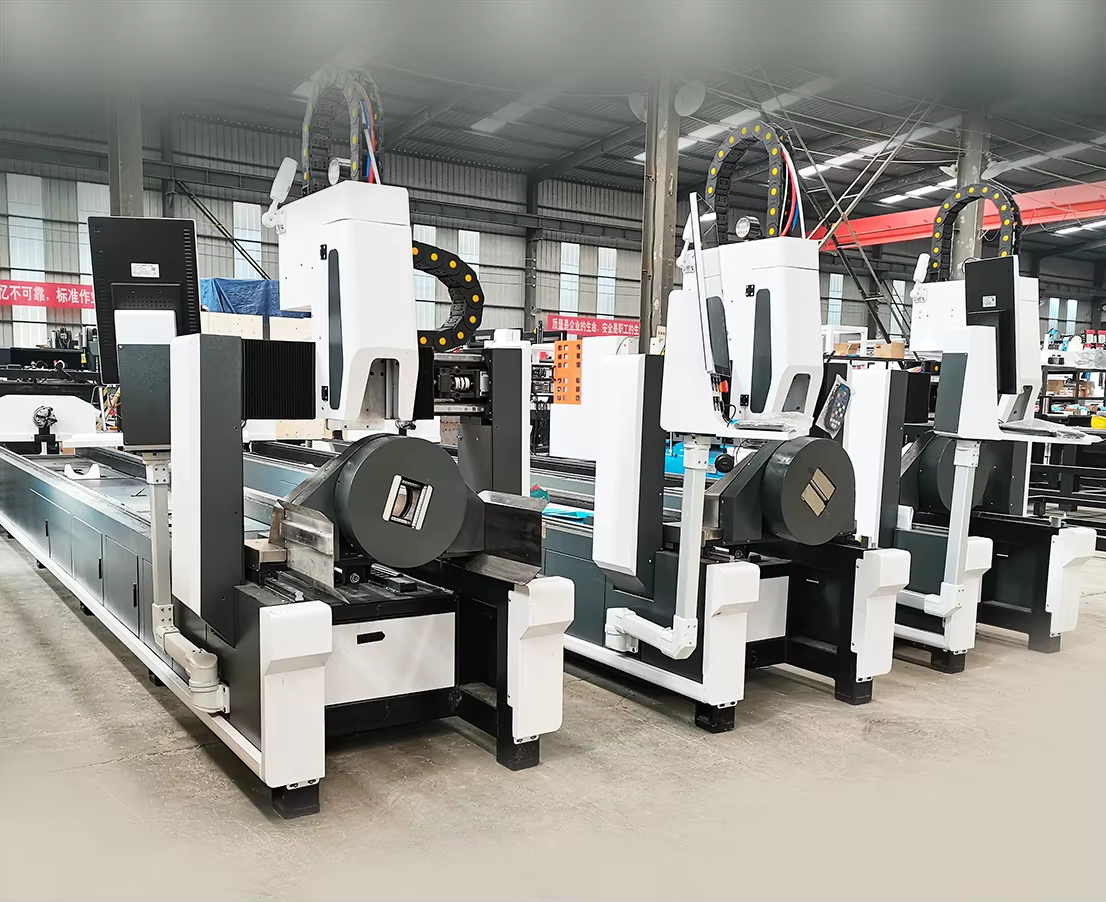
Achieving dimensional accuracy in complex tube geometries requires sophisticated kerf compensation algorithms. As the fiber laser resonator emits the beam, the bus CNC system calculates the precise width of the cut based on material thickness and gas pressure. By adjusting the tool path in real-time, the machine ensures that the finished part matches the CAD model within tolerances of +/- 0.05mm. A critical factor in this precision is the management of the heat-affected zone (HAZ). By utilizing high-frequency pulsing and optimized gas flow, manufacturers can minimize the thermal footprint, preventing the deformation of thin-walled tubes and ensuring the structural integrity of the material edge.
The most significant advancement in precision and cost-efficiency is the 3-chuck zero-tailing technology. In a traditional two-chuck configuration, a significant portion of the tube—often 200mm to 300mm—remains clamped and cannot be processed, resulting in material waste. A three-chuck system allows for the mid-cutting transition where the third chuck supports the part while the first and second chucks reposition. This enables “zero-tailing,” effectively utilizing the entire length of the raw material. For manufacturers processing high-cost alloys or stainless steel, the reduction in scrap directly contributes to a faster amortization of the machine cost.
Material Adaptability and Optical Modulation
A versatile CNC tube laser must navigate the distinct metallurgical properties of carbon steel, stainless steel, and non-ferrous reflective materials. The high-speed fiber laser oscillator provides the necessary beam quality to transition between these materials seamlessly. When processing carbon steel, the system typically utilizes oxygen as a cutting gas to facilitate an exothermic reaction, increasing cutting speeds on thicker walls. Conversely, stainless steel requires high-pressure nitrogen to produce an oxide-free, bright edge that is ready for immediate welding.
Reflective materials, such as aluminum and brass, present a unique challenge due to the risk of back-reflection damaging the fiber laser resonator. Modern tube lasers mitigate this through the use of optical isolators and advanced beam modulation. By fine-tuning the pulse frequency and duty cycle within the bus CNC system, the laser can pierce and cut reflective surfaces without compromising the internal optics. Furthermore, the auto-focus cutting head adjusts the focal position during the process to compensate for variations in material straightness, ensuring a consistent kerf across the entire length of the workpiece.
Automated Tube Loading and Nesting Efficiency
To achieve maximum ROI, the integration of an automated tube loading system is essential. Manual loading introduces human error and creates bottlenecks that negate the speed of the fiber laser. An automated bundle loader can sequence round, square, and open-profile tubes into the feeding mechanism without operator intervention. These systems utilize sensors to detect tube orientation and weld seams, ensuring that holes and notches are placed correctly relative to the material’s structural features.
The synergy between hardware and software is realized through CNC nesting optimization. Industrial nesting software analyzes the production queue and arranges parts to minimize material waste and movement time. By calculating the most efficient path and utilizing “common line cutting”—where two parts share a single cut line—the software reduces the total number of pierces and the total distance traveled by the cutting head. This not only saves time but also extends the life of consumables like nozzles and protective windows.
Strategic ROI and Long-Term Value
Investing in a high-performance tube laser is a decision based on throughput capacity and the cost per part. The “best deals” in the industrial market are found in machines that balance high-end components—like Japanese servo motors and German rack-and-pinion systems—with efficient manufacturing processes. A machine equipped with a servo-driven support system ensures that even 12-meter tubes are processed with the same accuracy as shorter segments.
The integration of a bus CNC system allows for remote diagnostics and preventative maintenance alerts, reducing the likelihood of unplanned downtime. When evaluating a CNC tube laser cutter, the focus should remain on the total cost of ownership. By combining 3-chuck zero-tailing, an automated tube loading system, and advanced CNC nesting optimization, manufacturers can achieve a significant competitive advantage. The ability to process diverse materials with minimal waste and high dynamic precision ensures that the facility can meet the rigorous demands of sectors like automotive manufacturing, aerospace, and structural engineering. Final hardware selection should prioritize the stability of the high-speed fiber laser oscillator and the responsiveness of the pneumatic full-stroke chucks, as these components form the foundation of a high-yield production line.
Advanced Fiber Laser Tube Processing Technology
Our CNC Fiber Laser Tube Cutting systems revolutionize metal fabrication by integrating high-precision cutting, punching, and profiling into a single automated workflow. Designed for versatility, this technology handles a wide array of profiles including Round, Square, Rectangular, and Oval tubes, as well as complex L-shaped and U-shaped channels.
- Precision Punching: High-speed hole punching with micron-level accuracy, eliminating the need for mechanical drilling or die-stamping.
- Complex Profiling: Advanced 3D pathing allows for intricate interlocking joints and specialized notch cuts, ideal for structural frames.
- High Material Efficiency: Intelligent nesting software minimizes scrap, reducing raw material costs across large production runs.
- Clean Finish: Delivers oxide-free, burr-free edges that require zero secondary grinding before welding.

Seamlessly processing multiple profiles with consistent precision.
Global Delivery & Logistics



From our high-tech manufacturing facility directly to your global site. PCL WeldCut ensures secure packaging, professional handling, and reliable international logistics to safeguard your equipment throughout the entire journey.
