2026 Industrial Benchmark: Next-Generation Fiber Laser Tube Processing Systems
Mechanical Kinematics and Dynamic Performance
The 2026 generation of industrial tube laser cutting machines is defined by a shift toward ultra-high-speed dynamics and structural damping. At the core of these systems is the high-speed fiber laser oscillator, which requires a motion platform capable of maintaining sub-micron accuracy while operating at accelerations exceeding 1.5G. To achieve this, modern gantry structures utilize high-tensile strength manganese steel or aerospace-grade aluminum crossbeams, stress-relieved through vibration aging and high-temperature tempering.
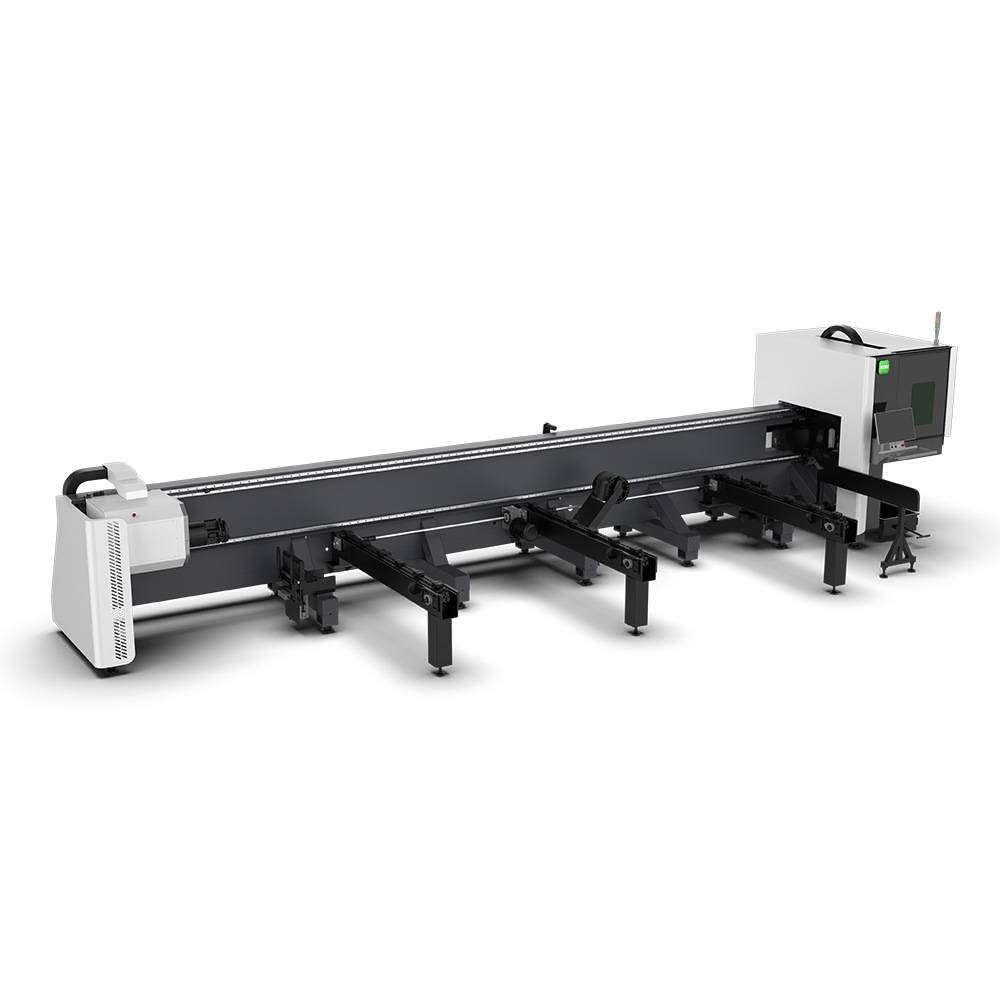
Dynamic performance is further dictated by the pneumatic full-stroke chuck assembly. Unlike traditional manual or stepped chucks, the 2026 pneumatic systems provide instantaneous clamping without the need for jaw adjustments across varying diameters. This allows for a significant increase in rotation speed (RPM), with high-tier models now reaching 150 RPM. High rotational velocity, synchronized with longitudinal gantry movement via a high-speed bus CNC system, ensures that complex geometries—such as interlocking joints and decorative filigree—are executed without corner deceleration lag. The integration of servo-driven support mechanisms prevents tube oscillation or “whipping” during high-speed rotations, maintaining the focal point precisely on the material surface regardless of the tube length or weight distribution.
Precision Engineering and Zero-Tailing Architectures
Precision in tube fabrication is no longer measured solely by the quality of the cut, but by the efficiency of material utilization. The implementation of 3-chuck zero-tailing technology represents the current pinnacle of engineering in this sector. By utilizing a mobile middle chuck that works in tandem with the feed and discharge chucks, the system can pass the material through the cutting zone with continuous support. This allows the laser head to process the very end of the workpiece, reducing the scrap “tailing” to nearly zero. In high-volume production, this translates to a 10% to 15% reduction in raw material costs annually.
Furthermore, the 2026 systems utilize advanced kerf compensation algorithms within the bus CNC system. As the fiber laser resonator generates the beam, the software automatically calculates the material loss (kerf) based on the specific nozzle diameter and gas pressure, adjusting the tool path in real-time. This precision is critical for managing the heat-affected zone (HAZ). By optimizing the pulse frequency and peak power of the high-speed fiber laser oscillator, these machines minimize thermal diffusion into the surrounding substrate. A narrower HAZ ensures that the metallurgical properties of the tube—especially in thin-walled stainless steel or chrome-moly—remain intact, preventing brittleness and ensuring weld integrity in post-processing stages.
Material Adaptability and Resonator Optimization
The versatility of a tube laser in 2026 is measured by its ability to transition between carbon steel and highly reflective non-ferrous alloys without manual recalibration. The latest fiber laser resonators are equipped with back-reflection isolation technologies, which protect the internal optical components from the “bounce-back” energy characteristic of cutting aluminum, brass, and copper. When processing aluminum, the system utilizes high-pressure nitrogen to rapidly expel molten material, resulting in a dross-free finish that requires no secondary grinding.
For carbon steel, the focus shifts to oxygen-assisted cutting and piercing speed. The bus CNC system manages multi-stage piercing cycles, gradually increasing power to prevent “pop-shot” damage on thick-walled sections. For stainless steel, the integration of frequency-modulated beam shaping allows the operator to toggle between a focused high-intensity beam for speed and a broader beam profile for improved edge smoothness. This adaptability is facilitated by intelligent gas mixing stations that automatically adjust the ratio of assist gases based on the material sensors located within the cutting head, ensuring optimal surface finishes across diverse material profiles including square, round, D-shaped, and open-channel sections.
Automation, CNC Nesting, and ROI Analysis
The transition from a standalone cutting tool to a fully integrated production cell is driven by the automated tube loading system. These systems utilize hydraulic or pneumatic lifters to pull individual tubes from a 3-ton bundle loader, orienting them via infrared sensors before feeding them into the pneumatic full-stroke chuck. This eliminates the manual labor associated with material handling and ensures that the machine operates at a high duty cycle, often exceeding 90% uptime.
Maximizing Return on Investment (ROI) is heavily dependent on CNC nesting optimization. Modern software suites now integrate directly with ERP systems, allowing for real-time job queuing and material tracking. The nesting algorithms analyze the entire production schedule to “bridge” parts together or utilize “common line cutting,” where a single laser pass separates two distinct parts. This not only reduces the total number of pierces—extending the life of the copper nozzles and protective windows—but also significantly reduces the total cycle time per part.
When evaluating a tube laser for sale in 2026, the technical synergy between the hardware (the servo-driven support and chucks) and the software (the CNC nesting optimization) is the primary driver of value. A system that minimizes human intervention through an automated tube loading system while maximizing material yield via 3-chuck zero-tailing technology provides a shorter payback period. By focusing on these high-end technical dimensions, manufacturers can ensure their facility remains competitive in an increasingly automated global supply chain.
Advanced Fiber Laser Tube Processing Technology
Our CNC Fiber Laser Tube Cutting systems revolutionize metal fabrication by integrating high-precision cutting, punching, and profiling into a single automated workflow. Designed for versatility, this technology handles a wide array of profiles including Round, Square, Rectangular, and Oval tubes, as well as complex L-shaped and U-shaped channels.
- Precision Punching: High-speed hole punching with micron-level accuracy, eliminating the need for mechanical drilling or die-stamping.
- Complex Profiling: Advanced 3D pathing allows for intricate interlocking joints and specialized notch cuts, ideal for structural frames.
- High Material Efficiency: Intelligent nesting software minimizes scrap, reducing raw material costs across large production runs.
- Clean Finish: Delivers oxide-free, burr-free edges that require zero secondary grinding before welding.

Seamlessly processing multiple profiles with consistent precision.
Global Delivery & Logistics



From our high-tech manufacturing facility directly to your global site. PCL WeldCut ensures secure packaging, professional handling, and reliable international logistics to safeguard your equipment throughout the entire journey.
