Defining the Benchmark for 2026 CNC Fiber Laser Tube Processing
The landscape of industrial tube fabrication in 2026 is defined by the convergence of ultra-high-speed kinematics and intelligent material handling. As manufacturing requirements shift toward high-mix, low-volume production with tighter tolerance requirements, the selection of a CNC fiber laser tube cutting machine must be predicated on its ability to maintain structural integrity under extreme dynamic loads. The 2026 benchmark for high-tier machinery centers on a dual-drive gantry architecture capable of exceeding 1.5G acceleration while maintaining a positioning accuracy of ±0.03mm. This level of performance is necessitated by the increasing complexity of profile geometries, including square, rectangular, D-shaped, and various open-profile channels.
Dynamic Performance and Kinematic Stability
Dynamic performance in 2026 is no longer solely about linear travel speeds but the synchronization between the gantry movements and the pneumatic full-stroke chuck rotation. Leading systems utilize high-inertia servo motors coupled with high-precision planetary reducers to achieve chuck rotation speeds of 120 to 150 RPM. This rotational velocity must be balanced with gantry stability, typically achieved through a high-strength, stress-relieved welded bed or a mineral casting base designed to dampen the harmonic vibrations generated during high-frequency micro-cutting.
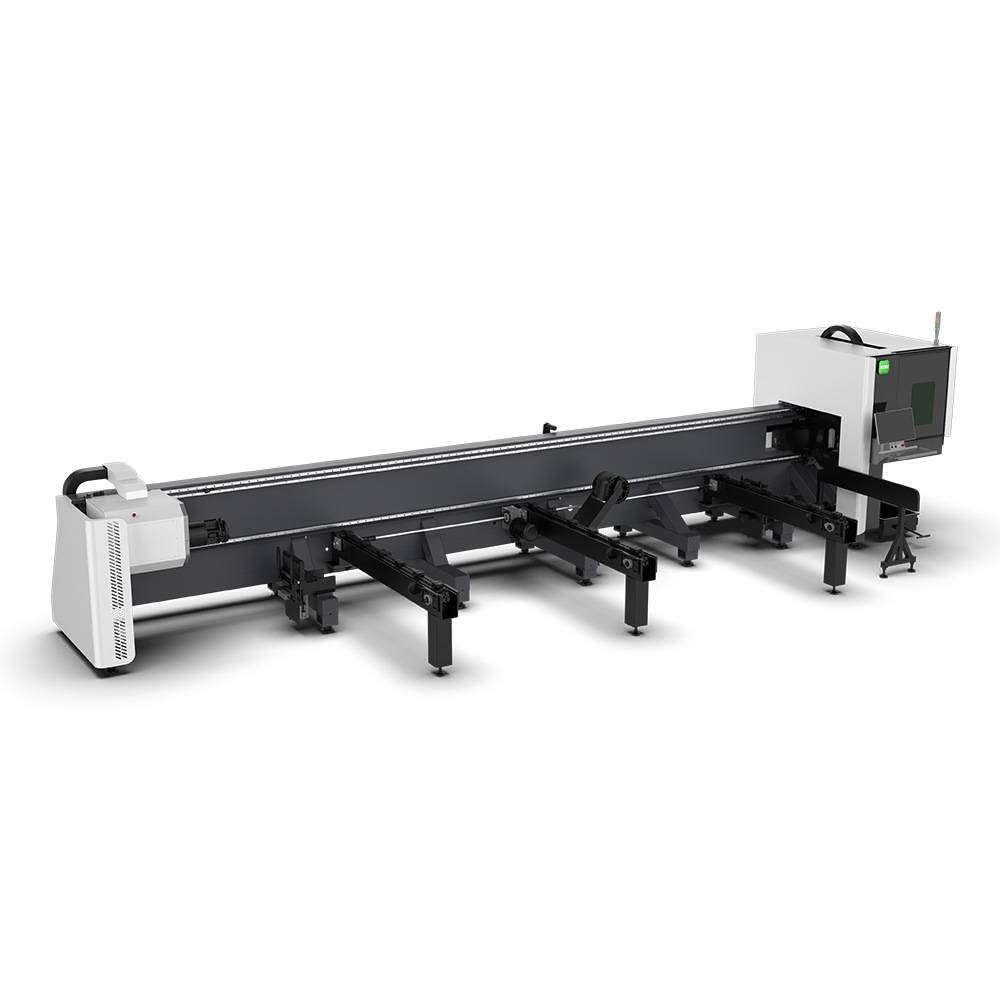
A critical component in maintaining this stability is the servo-driven support system. As the tube rotates and advances through the machine, the center of gravity shifts. Intelligent follow-up supports adjust their height in real-time based on the cross-sectional profile of the material, preventing oscillation and ensuring that the focal point of the high-speed fiber laser oscillator remains constant relative to the material surface. This synchronization is managed by a high-speed bus CNC system, utilizing EtherCAT communication protocols to ensure microsecond-level feedback loops between the laser source, the motion controller, and the material supports.
Precision Engineering and Zero-Tailing Technology
The economic viability of tube processing is increasingly tied to material utilization. Traditional two-chuck systems often leave a significant “tailing” of unprocessed material, leading to substantial waste. The 2026 standard for high-efficiency production incorporates 3-chuck zero-tailing technology. In this configuration, three independent pneumatic full-stroke chucks—the feeding chuck, the middle chuck, and the finished-part chuck—work in tandem to pass the material through the cutting zone. This allows for “pulling” the material through the final cut, reducing waste to near-zero and significantly lowering the cost per part in high-value alloy applications.
Precision is further enhanced through advanced kerf compensation algorithms. As the fiber laser interacts with the material, the width of the cut (kerf) varies based on material thickness and nozzle geometry. The CNC system must dynamically adjust the tool path to account for this variation, ensuring that complex interlocking joints or tabs fit together with interference-fit precision. Furthermore, the management of the Heat-Affected Zone (HAZ) has become more sophisticated. By utilizing ultra-short pulse capabilities within the fiber laser oscillator and optimized gas dynamics, modern machines can minimize thermal deformation. This is particularly vital when processing thin-walled tubes where excessive heat input can lead to structural warping or metallurgical changes that complicate subsequent welding processes.
Material Adaptability and Oscillator Integration
The versatility of the 2026 fiber laser tube cutter is driven by the integration of a high-speed fiber laser oscillator with power ranges typically spanning 6kW to 12kW for standard industrial applications. This power density allows for the rapid processing of carbon steel and stainless steel using oxygen or nitrogen as assist gases. However, the true mark of a premium machine is its ability to handle highly reflective materials such as aluminum, copper, and brass.
Reflective material processing is made possible through back-reflection protection mechanisms within the resonator and the delivery fiber. When cutting aluminum, the CNC system employs specific frequency and duty cycle parameters to pierce the material cleanly before transitioning to a high-speed cut. For carbon steel, the use of zoom heads—which can automatically adjust the beam spot size and shape—allows for high-speed cutting of thin sections and stable, high-quality cutting of thick-walled pipes using the same optical setup. This adaptability ensures that the machine remains a multi-purpose asset capable of shifting between diverse contract requirements without manual hardware reconfiguration.
Automation and ROI Through CNC Nesting Optimization
The transition from a standalone machine to a fully integrated production cell is facilitated by an automated tube loading system. These systems utilize bundle loaders or chain-style conveyors to feed raw stock into the machine with minimal human intervention. The integration of infrared sensors and laser profilers allows the machine to verify the cross-section and length of the raw material before it enters the chucks, preventing collisions and identifying material defects before processing begins.
The core of the return on investment (ROI) lies in the software ecosystem. CNC nesting optimization algorithms are now capable of multi-part nesting across different tube lengths, maximizing the number of parts per raw length and further reducing scrap. These software suites integrate directly with ERP systems, providing real-time data on gas consumption, electricity usage, and cycle times. By reducing the idle time associated with manual loading and manual nesting, facilities can achieve a 40% increase in daily output compared to previous-generation systems.
In conclusion, the best CNC fiber laser tube cutting machine for 2026 is defined by its ability to merge extreme kinematic speed with surgical precision. Through the implementation of 3-chuck zero-tailing technology, high-speed fiber laser oscillators, and a robust bus CNC system, manufacturers can achieve unprecedented levels of efficiency. The integration of an automated tube loading system ensures that the machine operates at peak capacity, turning raw material into finished components with the highest possible yield and the lowest possible thermal impact. For the modern industrial enterprise, these technical advancements represent the difference between standard production and market-leading performance.
Advanced Fiber Laser Tube Processing Technology
Our CNC Fiber Laser Tube Cutting systems revolutionize metal fabrication by integrating high-precision cutting, punching, and profiling into a single automated workflow. Designed for versatility, this technology handles a wide array of profiles including Round, Square, Rectangular, and Oval tubes, as well as complex L-shaped and U-shaped channels.
- Precision Punching: High-speed hole punching with micron-level accuracy, eliminating the need for mechanical drilling or die-stamping.
- Complex Profiling: Advanced 3D pathing allows for intricate interlocking joints and specialized notch cuts, ideal for structural frames.
- High Material Efficiency: Intelligent nesting software minimizes scrap, reducing raw material costs across large production runs.
- Clean Finish: Delivers oxide-free, burr-free edges that require zero secondary grinding before welding.

Seamlessly processing multiple profiles with consistent precision.
Global Delivery & Logistics



From our high-tech manufacturing facility directly to your global site. PCL WeldCut ensures secure packaging, professional handling, and reliable international logistics to safeguard your equipment throughout the entire journey.
