ADVANCEMENTS IN STRUCTURAL STEEL FABRICATION THROUGH HIGH-SPEED FIBER LASER TECHNOLOGY
The evolution of structural steel fabrication for modern construction has shifted from traditional mechanical processing toward integrated thermal cutting solutions. The implementation of high-speed fiber laser oscillators within tube-specific CNC platforms represents a critical advancement in how structural sections—including hollow structural sections (HSS), I-beams, and channels—are prepared for assembly. This transition is driven by the need for tighter tolerances in modular construction and the optimization of material yield through high-speed automation.
DYNAMIC PERFORMANCE AND MOTION CONTROL STABILITY
The foundational architecture of a structural steel tube laser cutting machine relies on high-torque dynamic performance to handle the substantial mass of heavy-wall profiles. Modern systems utilize a reinforced gantry structure, often fabricated from high-strength welded steel or mineral casting, to maintain gantry stability during rapid directional changes. High acceleration rates, often exceeding 1.2G, are essential for maintaining constant velocity through complex geometries, such as miter cuts or saddle joints.
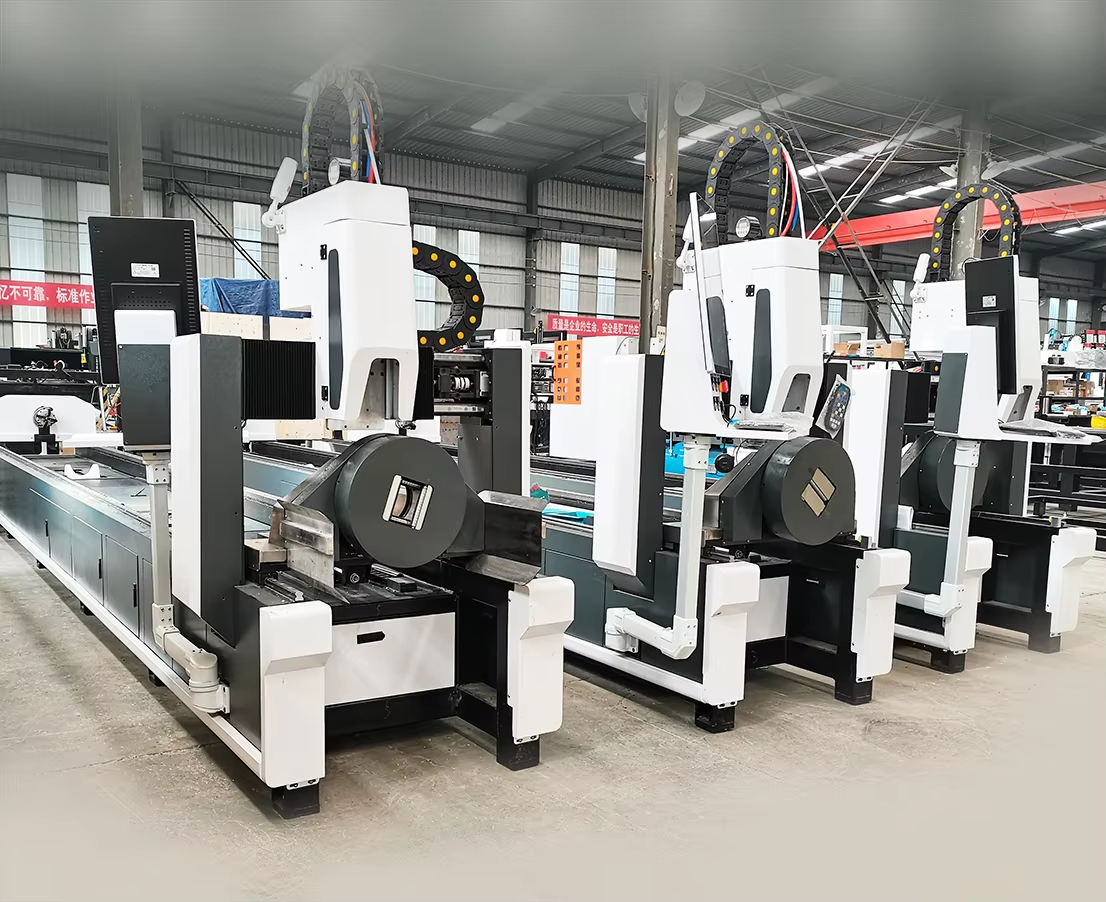
Central to this dynamic capability is the pneumatic full-stroke chuck system. Unlike traditional manual chucks, these servo-driven components provide synchronous rotation with high RPM capabilities, ensuring that even large-diameter tubes maintain concentricity at speed. The integration of a bus CNC system allows for real-time synchronization between the linear axes and the rotational movement of the chucks. This ultra-fast communication protocol ensures that the high-speed fiber laser oscillator maintains its focal point relative to the workpiece, even when processing irregular structural shapes that exhibit significant centrifugal force during rotation.
PRECISION ENGINEERING AND THERMAL MANAGEMENT
Structural integrity in construction depends heavily on the precision of the fit-up. Precision engineering in laser tube cutting is defined by the system’s ability to manage kerf compensation and the Heat-Affected Zone (HAZ). Fiber laser resonators produce a highly concentrated beam with a wavelength of approximately 1.07 microns, which results in a significantly narrower HAZ compared to plasma or oxy-fuel cutting. This reduction in thermal deformation ensures that the mechanical properties of the steel remain intact, facilitating high-quality weld penetration in downstream assembly.
To further enhance material utilization, leading systems employ 3-chuck zero-tailing technology. In a standard two-chuck configuration, a significant portion of the tube—the “remnant”—cannot be processed because it must remain clamped. A three-chuck system allows for the hand-off of the workpiece between the feed chuck, the middle chuck, and the finish chuck. This allows the laser head to cut extremely close to the clamping point, virtually eliminating scrap and providing a massive increase in raw material ROI. When combined with a bus CNC system, the machine can execute real-time kerf compensation, adjusting the beam path to account for the thickness of the laser cut and ensuring that interlocking parts fit with sub-millimeter accuracy.
MATERIAL ADAPTABILITY AND OSCILLATOR PARAMETERS
Structural projects frequently require a diverse range of materials, each requiring specific gas dynamics and laser parameters. For carbon steel, which comprises the bulk of structural frameworks, the high-speed fiber laser oscillator typically utilizes oxygen as an assistant gas. This creates an exothermic reaction that accelerates cutting speeds in thick-walled sections. Conversely, for stainless steel components used in architectural or corrosive environments, nitrogen is employed to prevent oxidation, resulting in a clean, weld-ready edge that requires no secondary grinding.
A significant challenge in laser processing is the handling of reflective materials like aluminum and brass. Modern fiber laser resonators are equipped with back-reflection isolators that protect the internal optical components from reflected light. Furthermore, servo-driven support systems play a vital role here; as the tube rotates, these supports move vertically to compensate for tube sagging or bowing, which is common in aluminum profiles. This constant support ensures the laser maintains a consistent nozzle-to-workpiece standoff distance, which is critical for maintaining beam focus across different material densities.
AUTOMATION SYSTEMS AND OPERATIONAL ROI
The primary driver for the adoption of laser tube cutting in construction is the drastic reduction in man-hours per ton of steel. This efficiency is realized through the integration of an automated tube loading system. These systems utilize hydraulic or pneumatic lifts to transition raw bundles of steel into the feeding lane, where sensors detect the profile type and orientation. By automating the material handling phase, fabricators can achieve near-continuous operation, significantly increasing the machine’s duty cycle.
Software integration further amplifies these gains. CNC nesting optimization algorithms analyze the required parts list and calculate the most efficient layout on a standard length of tube. This software accounts for the 3-chuck zero-tailing technology, nesting parts into the tail-end of the previous section to minimize waste. The output of the CNC nesting optimization is then sent directly to the bus CNC system, which manages the entire cutting sequence without manual intervention.
By consolidating sawing, drilling, milling, and marking into a single automated process, structural steel laser machines provide a streamlined workflow. The elimination of secondary processing, combined with the precision of fiber laser technology, allows construction firms to move from digital design to physical assembly with unprecedented speed and accuracy. This synergy of dynamic performance, material adaptability, and automated logistics defines the next generation of structural steel fabrication.
Advanced Fiber Laser Tube Processing Technology
Our CNC Fiber Laser Tube Cutting systems revolutionize metal fabrication by integrating high-precision cutting, punching, and profiling into a single automated workflow. Designed for versatility, this technology handles a wide array of profiles including Round, Square, Rectangular, and Oval tubes, as well as complex L-shaped and U-shaped channels.
- Precision Punching: High-speed hole punching with micron-level accuracy, eliminating the need for mechanical drilling or die-stamping.
- Complex Profiling: Advanced 3D pathing allows for intricate interlocking joints and specialized notch cuts, ideal for structural frames.
- High Material Efficiency: Intelligent nesting software minimizes scrap, reducing raw material costs across large production runs.
- Clean Finish: Delivers oxide-free, burr-free edges that require zero secondary grinding before welding.

Seamlessly processing multiple profiles with consistent precision.
Global Delivery & Logistics



From our high-tech manufacturing facility directly to your global site. PCL WeldCut ensures secure packaging, professional handling, and reliable international logistics to safeguard your equipment throughout the entire journey.