Engineering Specifications for High-Precision Fiber Laser Tube Processing Systems
The evolution of structural metal fabrication is currently defined by the transition from conventional mechanical sawing and milling to high-speed fiber laser oscillator integration. For industrial suppliers and manufacturers, the deployment of a CNC tube laser cutter represents a fundamental shift in throughput capacity and dimensional accuracy. Achieving sub-millimeter precision in complex geometries requires a synergetic relationship between mechanical rigidity, optical beam quality, and real-time control logic.
Dynamic Performance and Kinematic Stability
The operational efficiency of a CNC tube laser is dictated by its dynamic performance parameters, specifically the acceleration rates and the rotational velocity of the chucking system. Modern high-precision systems utilize a gantry structure fabricated from high-strength aviation-grade aluminum or stress-relieved heavy-duty steel weldments. This structural integrity is critical for maintaining stability when the cutting head executes high-frequency directional changes.
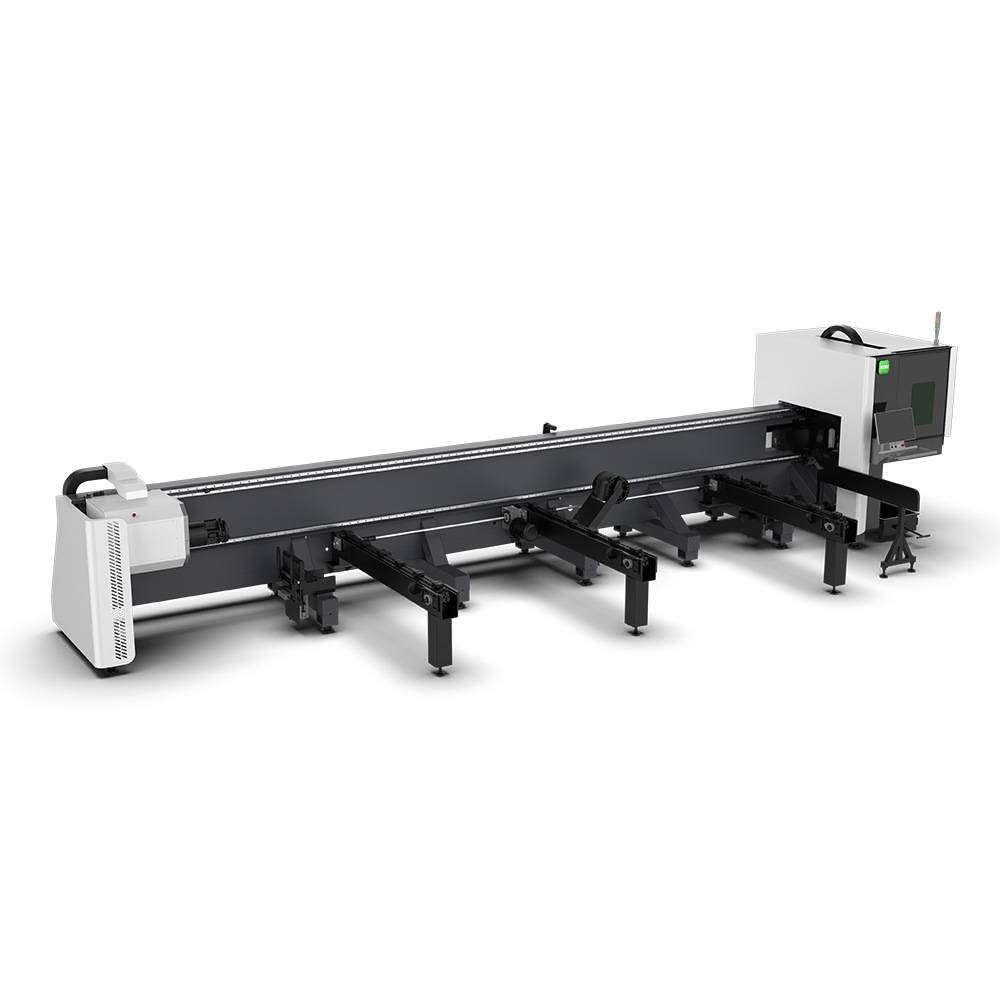
In high-speed processing, the gantry must sustain acceleration forces up to 1.5G while maintaining a positioning accuracy within ±0.03mm. This is complemented by the pneumatic full-stroke chuck, which eliminates the need for manual jaw adjustments across varying tube diameters. These chucks are engineered for high RPM (revolutions per minute) capability, often exceeding 120 RPM, allowing for rapid indexing and continuous rotation during complex 4-axis or 5-axis cutting maneuvers. To prevent tube oscillation or “whip” during high-speed rotation, a servo-driven support system is integrated. This system utilizes intelligent height sensing to provide active damping and physical support, ensuring the centerline of the workpiece remains perfectly aligned with the optical axis.
Precision Engineering and Zero-Tailing Technology
Precision in tube laser cutting is not merely a function of the fiber laser resonator’s power but is heavily dependent on the management of the Heat Affected Zone (HAZ) and kerf compensation. The bus CNC system calculates the kerf—the width of the material removed by the laser—in real-time, adjusting the beam path to ensure that finished dimensions match the CAD/CAM specifications exactly. By modulating the frequency and pulse width of the laser, the system minimizes thermal input, thereby reducing the HAZ. This is particularly vital when processing thin-walled tubes where excessive heat leads to structural deformation or dross accumulation on the interior profile.
One of the most significant advancements in material efficiency is the 3-chuck zero-tailing technology. Traditional 2-chuck systems often leave a substantial “dead zone” or scrap tailing at the end of each tube, sometimes exceeding 200mm. A 3-chuck configuration allows for the physical handover of the workpiece between the rear, middle, and front chucks. This enables the laser head to cut extremely close to the clamping point or even “behind” the chuck. The result is a dramatic reduction in material waste, with some systems achieving a near-zero tailing (under 20mm), which directly impacts the bottom-line profitability of high-volume production runs.
Material Adaptability and Optical Modulation
The versatility of a high-speed fiber laser oscillator allows for the processing of a wide spectrum of alloys, each requiring specific gas dynamics and optical parameters. Carbon steel is typically processed using oxygen as an assist gas, where the exothermic reaction enhances cutting speeds. Conversely, stainless steel requires high-pressure nitrogen to prevent oxidation and ensure a clean, burr-free edge that requires no secondary finishing.
Reflective materials, such as aluminum, brass, and copper, pose a unique challenge due to the risk of back-reflection damaging the fiber laser resonator. Modern industrial tube lasers mitigate this through the use of optical isolators and advanced beam delivery systems. The bus CNC system manages the power ramping at corners—slowing down the feed rate while simultaneously lowering the laser power—to prevent over-melting on intricate geometries. This level of control ensures that even highly reflective aluminum tubes can be processed with the same consistency as mild steel, maintaining tight tolerances on slotting, hole-drilling, and miter cuts.
Automation Integration and ROI Optimization
The transition from a standalone machine to a fully integrated production cell is facilitated by the automated tube loading system. In an industrial environment, the downtime associated with manual material handling significantly degrades the Return on Investment (ROI). An automated bundle loader can sequence round, square, and rectangular profiles, feeding them into the pneumatic full-stroke chuck without operator intervention. This allows for “lights-out” manufacturing and ensures that the high-speed fiber laser oscillator maintains a high duty cycle.
Furthermore, the integration of CNC nesting optimization software is the primary driver of material efficiency. Advanced nesting algorithms analyze the production queue to arrange parts of varying lengths and geometries on a single tube, minimizing scrap. This software also handles “common line cutting,” where two parts share a single cut path, reducing the total distance traveled by the cutting head and extending the life of consumables like nozzles and protective windows.
The data feedback loop provided by the bus CNC system allows for real-time monitoring of gas pressure, laser stability, and component wear. By analyzing these metrics, facility managers can move from reactive maintenance to a predictive model, ensuring the CNC tube laser cutter operates at peak performance. For any high-precision supplier, the combination of dynamic mechanical performance, zero-tailing precision, and automated workflow creates a scalable foundation for meeting the rigorous demands of modern aerospace, automotive, and structural engineering sectors. Through the strategic application of these technologies, manufacturers can achieve a superior surface finish, eliminate secondary processing steps, and significantly reduce the cost-per-part in complex tube fabrication.
Advanced Fiber Laser Tube Processing Technology
Our CNC Fiber Laser Tube Cutting systems revolutionize metal fabrication by integrating high-precision cutting, punching, and profiling into a single automated workflow. Designed for versatility, this technology handles a wide array of profiles including Round, Square, Rectangular, and Oval tubes, as well as complex L-shaped and U-shaped channels.
- Precision Punching: High-speed hole punching with micron-level accuracy, eliminating the need for mechanical drilling or die-stamping.
- Complex Profiling: Advanced 3D pathing allows for intricate interlocking joints and specialized notch cuts, ideal for structural frames.
- High Material Efficiency: Intelligent nesting software minimizes scrap, reducing raw material costs across large production runs.
- Clean Finish: Delivers oxide-free, burr-free edges that require zero secondary grinding before welding.

Seamlessly processing multiple profiles with consistent precision.
Global Delivery & Logistics



From our high-tech manufacturing facility directly to your global site. PCL WeldCut ensures secure packaging, professional handling, and reliable international logistics to safeguard your equipment throughout the entire journey.