Strategic Engineering and Economic Assessment of High-Performance Tube Laser Systems
High-speed fiber laser oscillator technology has fundamentally transitioned the metal fabrication landscape from traditional mechanical sawing and drilling to integrated CNC thermal processing. For global procurement specialists and industrial manufacturers, evaluating a tube laser cutting machine supplier wholesale price requires a deep technical understanding of the hardware architecture and its long-term operational impact on the production floor. This whitepaper analyzes the mechanical and digital benchmarks that define modern tube laser efficiency.
Dynamic Performance and Kinematic Stability
The throughput of a tube laser system is dictated by its dynamic performance parameters, specifically the synchronization between linear gantry movement and rotational chuck velocity. High-tier industrial systems utilize a high-speed fiber laser oscillator paired with a lightweight, high-rigidity gantry typically constructed from aerospace-grade extruded aluminum. This architecture allows for accelerations exceeding 1.2G, which is critical for reducing “point-to-point” transition times during complex geometric cuts.
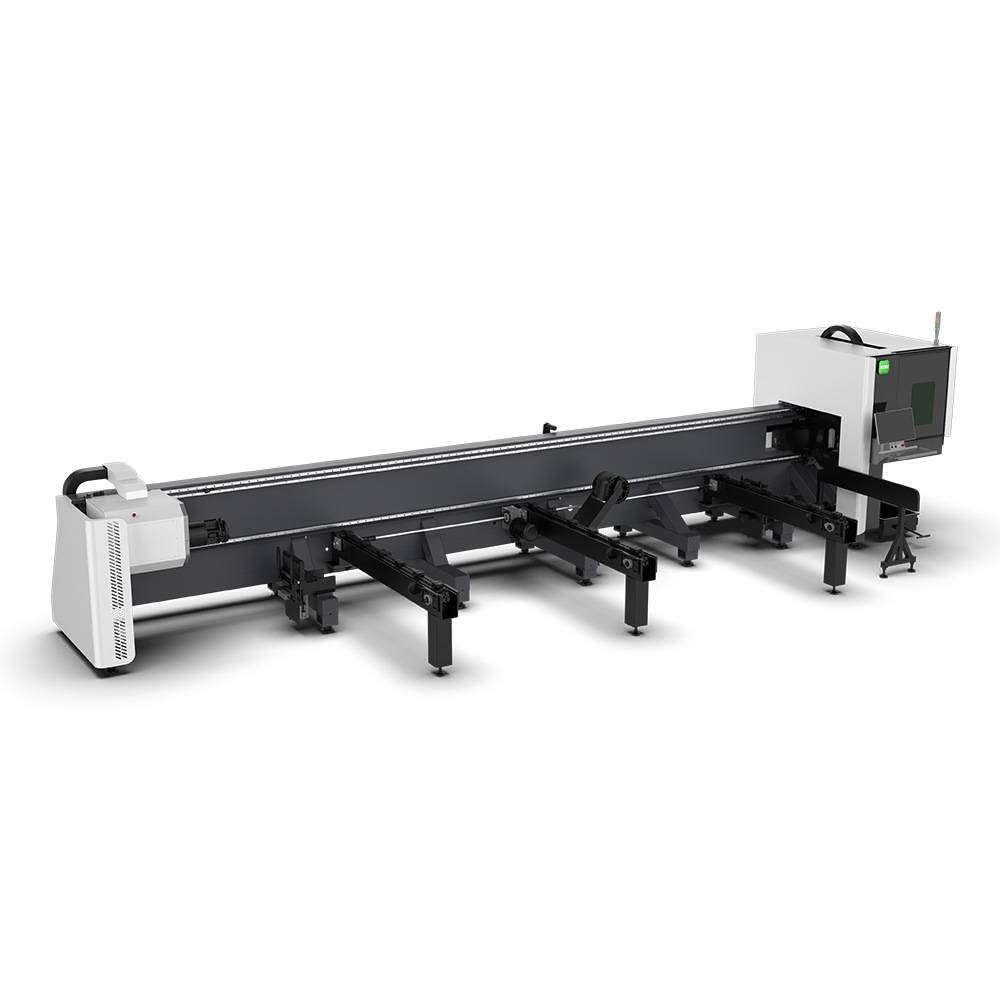
Crucial to this movement is the pneumatic full-stroke chuck. Unlike manual adjustment chucks, the pneumatic full-stroke variant eliminates the need for jaw changes when switching between tube diameters, ranging from 15mm to 220mm or larger. The rotation speed, often reaching 120-150 RPM, must be managed by a high-frequency bus CNC system to ensure that the tangential velocity remains constant during the cutting process. Furthermore, the integration of servo-driven support units is mandatory to counteract gravitational sagging in longer workpieces. These supports move vertically in real-time based on the rotational angle of the tube, maintaining the focal point at a precise perpendicular intersection with the material surface, thereby preventing geometric distortion in the final part.
Precision Engineering and Zero-Tailing Technology
Precision in laser tube processing is not merely a function of the fiber laser resonator but an outcome of advanced motion control and mechanical design. One of the most significant advancements in the industry is the 3-chuck zero-tailing technology. In a standard 2-chuck configuration, a significant portion of the material (the “tailing”) is wasted because the chuck cannot feed the material past the cutting head. A 3-chuck system—comprising a feeding chuck, a middle chuck, and a finished part chuck—allows the laser to cut between the chucks. This enables “zero-tailing” or ultra-short tailing, significantly reducing material waste and lowering the total cost per part, which is a vital metric when considering the ROI of the initial wholesale price.
Digital precision is further enhanced through sophisticated kerf compensation algorithms within the bus CNC system. As the laser beam melts and vaporizes the metal, a specific amount of material (the kerf) is removed. The software must automatically calculate this offset based on the material thickness and nozzle diameter. Furthermore, managing the Heat-Affected Zone (HAZ) is critical for downstream processes. By optimizing the pulse frequency and duty cycle of the fiber laser resonator, manufacturers can minimize the HAZ, ensuring that the metallurgical properties of the tube remain intact for subsequent welding or assembly operations.
Material Adaptability and Oscillator Efficiency
A high-performance tube laser must exhibit versatile material adaptability to handle the varying demands of industrial sectors. The interaction between the laser beam and the material is governed by the wavelength of the high-speed fiber laser oscillator and the auxiliary gas delivery system. For carbon steel, the use of Oxygen (O2) as an assist gas facilitates an exothermic reaction, increasing cutting speeds on thicker walls. Conversely, for stainless steel, Nitrogen (N2) is utilized to produce a clean, oxide-free edge that requires no secondary finishing.
The challenge of reflective materials, such as aluminum, brass, and copper, requires a fiber laser resonator equipped with back-reflection protection. Modern oscillators are designed to absorb reflected photons before they can damage the diode modules. When procuring from a supplier at a wholesale price level, it is essential to verify that the power density and beam quality (M2 factor) are optimized for these materials. Consistent cutting performance across varying alloys is achieved through automated gas pressure control and motorized focal position adjustment, allowing the system to transition from 6mm carbon steel to 3mm aluminum with minimal downtime.
Automation, CNC Nesting, and ROI
The transition from a standalone machine to a fully automated production cell is the primary driver of modern manufacturing profitability. An automated tube loading system is no longer an optional luxury but a core component of the system’s architecture. These systems utilize bundle loaders and singularization mechanisms to feed tubes into the machine continuously. This reduces labor costs and ensures that the high-speed fiber laser oscillator is engaged in cutting for the maximum percentage of the shift, rather than idling during manual loading cycles.
On the digital side, CNC nesting optimization plays a pivotal role in material utilization. Advanced nesting software analyzes the production queue and arranges parts of varying lengths and geometries on a single raw tube to minimize scrap. This software also handles “common line cutting,” where two parts share a single cut path, further reducing processing time and gas consumption.
When evaluating a tube laser cutting machine supplier wholesale price, the technical specification must be balanced against the projected ROI. A machine equipped with a bus CNC system, an automated tube loading system, and zero-tailing capabilities represents a higher initial capital expenditure but results in a significantly lower “cost per hole” and “cost per cut.” For industrial manufacturers, the integration of these high-performance components ensures a competitive advantage through increased throughput, superior part precision, and minimized material waste. High-speed fiber laser oscillators, combined with robust mechanical engineering, remain the benchmark for the modern fabrication facility.
Advanced Fiber Laser Tube Processing Technology
Our CNC Fiber Laser Tube Cutting systems revolutionize metal fabrication by integrating high-precision cutting, punching, and profiling into a single automated workflow. Designed for versatility, this technology handles a wide array of profiles including Round, Square, Rectangular, and Oval tubes, as well as complex L-shaped and U-shaped channels.
- Precision Punching: High-speed hole punching with micron-level accuracy, eliminating the need for mechanical drilling or die-stamping.
- Complex Profiling: Advanced 3D pathing allows for intricate interlocking joints and specialized notch cuts, ideal for structural frames.
- High Material Efficiency: Intelligent nesting software minimizes scrap, reducing raw material costs across large production runs.
- Clean Finish: Delivers oxide-free, burr-free edges that require zero secondary grinding before welding.

Seamlessly processing multiple profiles with consistent precision.
Global Delivery & Logistics



From our high-tech manufacturing facility directly to your global site. PCL WeldCut ensures secure packaging, professional handling, and reliable international logistics to safeguard your equipment throughout the entire journey.
