Kinematic Architecture and Dynamic Response in Entry-Level Tube Processing
The fundamental value proposition of a budget-conscious tube laser cutting machine lies in its ability to maintain high-speed kinematic performance without the prohibitive capital expenditure of high-end European systems. For small businesses, dynamic performance is measured by the synergy between the gantry acceleration and the pneumatic full-stroke chuck rotation. Modern entry-level machines utilize a bus CNC system to synchronize the four-axis or five-axis movement, allowing for acceleration rates reaching 1.0G to 1.2G. This is achieved through a low-inertia aluminum alloy gantry that has been optimized via finite element analysis (FEA) to minimize structural resonance during high-speed direction changes.
The rotational speed of the chuck, often exceeding 100 RPM, is critical for processing small-diameter tubing where the tangential speed must be maintained to ensure consistent cutting quality. By utilizing a high-speed fiber laser oscillator, the machine can process thin-walled sections at feed rates that challenge traditional mechanical saws. Stability is further enhanced by a servo-driven support system that prevents tube sagging and vibration, particularly in profiles exceeding six meters. This ensures that the focal point remains consistent relative to the tube surface, preventing dross formation and ensuring a clean severance.
Precision Engineering and Zero-Tailing Resource Management
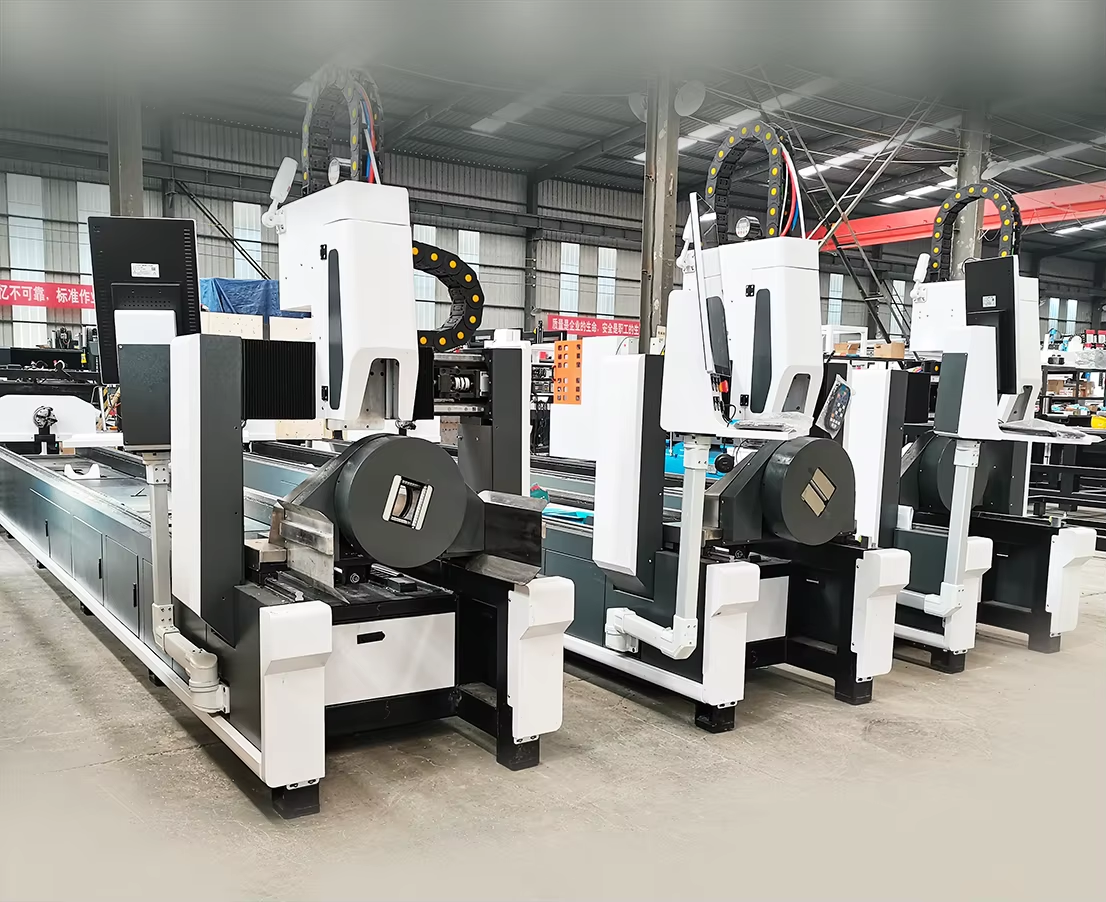
Precision in tube cutting is not merely a function of the laser source but of the mechanical handling of the workpiece. For small enterprises, material waste is a significant overhead. The integration of 3-chuck zero-tailing technology represents a major shift in ROI potential. In a standard two-chuck configuration, a significant remnant of the tube—often 200mm to 300mm—cannot be processed. However, a three-chuck system allows for the active transfer of the tube between the rear, middle, and front pneumatic full-stroke chucks, reducing the “dead zone” and achieving near-zero tailing. This allows the high-speed fiber laser oscillator to cut right to the edge of the material.
Furthermore, precision engineering involves sophisticated kerf compensation algorithms within the bus CNC system. As the laser beam removes a specific width of material, the software must adjust the toolpath in real-time to maintain dimensional tolerances of ±0.05mm. This is especially vital when managing the Heat-Affected Zone (HAZ). By optimizing the pulse frequency and duty cycle, the machine minimizes the thermal footprint on the material, preventing structural deformation in thin-walled stainless steel or the hardening of edges in high-carbon steel. This precision ensures that secondary processes, such as welding or assembly, do not require additional grinding or edge preparation.
Optical Propagation and Material Adaptability Parameters
The versatility of a tube laser cutting machine is defined by its ability to handle a diverse metallurgical portfolio. A high-speed fiber laser oscillator provides a wavelength of approximately 1.06 microns, which is ideal for absorption in both ferrous and non-ferrous metals. For carbon steel, the use of oxygen as an assist gas facilitates an exothermic reaction, significantly increasing cutting speeds in thicker sections. Conversely, for stainless steel, nitrogen is used as a high-pressure assist gas to blow away the molten metal, resulting in an oxide-free, bright-finish cut that is ready for immediate hygienic welding.
Small businesses often face challenges with reflective materials like aluminum and copper. Modern fiber laser resonators are equipped with back-reflection protection, allowing the system to process these materials without damaging the internal optics. The material adaptability is managed through a comprehensive library of cutting parameters stored within the bus CNC system. These parameters automatically adjust the gas pressure, focal position, and nozzle height via a capacitive height sensing head, which maintains a constant distance between the nozzle and the tube surface, even if the material is slightly bowed or out-of-round.
Operational Automation and Financial Scalability
For a small business to compete with larger service centers, the reduction of labor-intensive tasks is mandatory. An automated tube loading system transforms a manual operation into a semi-continuous production cycle. These systems use a bundle loader or a single-tube elevator to feed raw stock into the machine’s intake, where the pneumatic full-stroke chuck automatically centers the workpiece. This automation reduces the “idle time” between cycles, ensuring that the high-speed fiber laser oscillator maintains a high duty cycle throughout the shift.
Complementing the hardware is the role of CNC nesting optimization software. This software calculates the most efficient arrangement of parts on a single length of tubing, accounting for the kerf width and the rotation of the tube to minimize waste. Advanced nesting can even “bridge” parts together to reduce the number of lead-ins, thereby shortening the overall cycle time and reducing the consumption of assist gases. When combined with the low power consumption of a fiber laser resonator compared to older CO2 technology, the total cost of ownership (TCO) is significantly lowered. The efficiency gained through automated loading and optimized nesting allows small businesses to offer faster turnaround times and more competitive pricing, facilitating a rapid return on investment and the ability to scale production capabilities in line with market demand.
Advanced Fiber Laser Tube Processing Technology
Our CNC Fiber Laser Tube Cutting systems revolutionize metal fabrication by integrating high-precision cutting, punching, and profiling into a single automated workflow. Designed for versatility, this technology handles a wide array of profiles including Round, Square, Rectangular, and Oval tubes, as well as complex L-shaped and U-shaped channels.
- Precision Punching: High-speed hole punching with micron-level accuracy, eliminating the need for mechanical drilling or die-stamping.
- Complex Profiling: Advanced 3D pathing allows for intricate interlocking joints and specialized notch cuts, ideal for structural frames.
- High Material Efficiency: Intelligent nesting software minimizes scrap, reducing raw material costs across large production runs.
- Clean Finish: Delivers oxide-free, burr-free edges that require zero secondary grinding before welding.

Seamlessly processing multiple profiles with consistent precision.
Global Delivery & Logistics



From our high-tech manufacturing facility directly to your global site. PCL WeldCut ensures secure packaging, professional handling, and reliable international logistics to safeguard your equipment throughout the entire journey.
