Optimizing Industrial Fabrication: Technical Architecture of Automated Tube Laser Systems
Dynamic Kinematics and Structural Stability
The operational efficiency of a tube laser cutting machine is fundamentally dictated by its kinematic chain and the rigidity of its structural frame. In high-output environments, the machine must maintain structural integrity while navigating complex toolpaths at high acceleration rates, often exceeding 1.2G. This is achieved through a high-precision gantry system, typically constructed from aerospace-grade extruded aluminum to minimize moving mass without sacrificing stiffness. By reducing the moment of inertia, the system allows the high-speed fiber laser oscillator to maintain consistent beam delivery even during rapid directional changes.
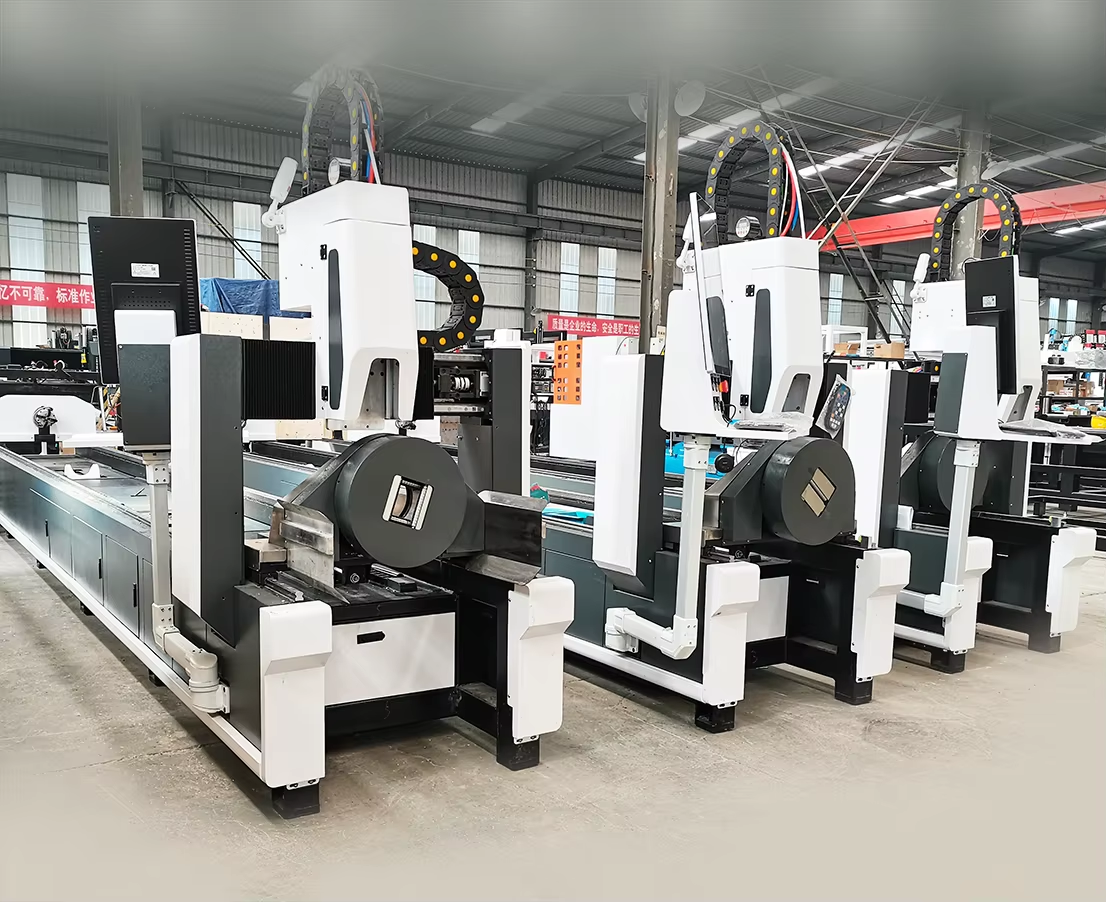
Central to dynamic performance is the rotational speed of the chucking system. Modern platforms utilize high-torque AC synchronous motors to drive the pneumatic full-stroke chuck at speeds reaching 120 to 150 RPM. This rotational velocity is critical for maintaining high feed rates on small-diameter profiles. To counter the centrifugal forces and vibrations inherent in high-speed rotation, a servo-driven support system is integrated. These active supports adjust in real-time to the tube’s geometry and weight distribution, preventing “whip” or sag in longer workpieces, which ensures that the focal point of the fiber laser resonator remains perfectly perpendicular to the material surface.
Advanced Precision Engineering and Zero Tailing
Precision in tube fabrication extends beyond simple dimensional accuracy; it involves the sophisticated management of material waste and thermal distortion. The integration of 3-chuck zero-tailing technology represents a significant leap in material utilization. In a standard two-chuck configuration, a portion of the tube remains clamped and unreachable by the cutting head, resulting in significant “slug” or tailing waste. The three-chuck architecture allows for the synchronized hand-off of the workpiece. As the laser reaches the end of the stock, the third chuck secures the piece, allowing the primary chucks to reset or move past the cutting zone. This allows for cutting at the very edge of the material, effectively reducing tailings to near-zero and maximizing the yield per raw length.
The precision of the cut is further refined through digital kerf compensation within the bus CNC system. As the laser beam melts the material, it creates a kerf (width of the cut). The CNC system automatically calculates the beam offset based on material thickness and nozzle diameter to ensure the finished part meets exacting tolerances. Furthermore, the management of the Heat-Affected Zone (HAZ) is paramount for secondary processes like welding or assembly. By utilizing high-frequency pulsing and optimized gas dynamics, the system minimizes the thermal footprint on the cut edge, preventing carbon precipitation in stainless steel and preserving the metallurgical integrity of the alloy.
Material Adaptability and Metallurgical Processing
A robust tube laser must exhibit versatile processing capabilities across a spectrum of ferrous and non-ferrous alloys. The interaction between the high-speed fiber laser oscillator and the material is governed by wavelength absorption and gas assistance. For carbon steel, the system typically employs oxygen-assisted cutting, utilizing the exothermic reaction to accelerate cutting speeds through thick-walled sections. Conversely, stainless steel processing relies on high-pressure nitrogen to shield the melt pool, ensuring a bright, oxide-free finish that requires no post-processing.
Reflective materials, such as aluminum, brass, and copper, present unique challenges due to back-reflection, which can damage optical components. Modern fiber laser resonators are equipped with optical isolators and advanced beam sensing to mitigate these risks. Aluminum fabrication, in particular, requires precise control over the power modulation to prevent dross adhesion on the internal walls of the tube. The bus CNC system dynamically adjusts laser power and gas pressure in correlation with the feed rate, ensuring that even when navigating tight radii or complex geometries, the cut quality remains uniform across varying thermal loads.
Integrated Automation and Economic ROI
The transition from manual material handling to an automated tube loading system is the primary driver of Return on Investment (ROI) in high-volume fabrication. Manual loading introduces significant downtime and human error, whereas an automated bundle loader can sequence raw stock into the machine with cycle times under 15 seconds. These systems utilize hydraulic or pneumatic lifters to select a single profile, verify its dimensions via sensors, and align it with the intake chuck. This allows the machine to operate in a “lights-out” capacity, significantly increasing the total parts produced per shift.
Synergizing with the hardware is the role of CNC nesting optimization software. This software analyzes the entire production queue and arranges parts on the raw tube stock to minimize scrap. It accounts for the 3-chuck movement limits and ensures that the heaviest cutting sequences are performed while the tube has maximum structural support. By integrating the nesting data directly into the bus CNC system via high-speed communication protocols, the machine can transition between different part designs without operator intervention. The reduction in labor costs, combined with a 15-20% increase in material utilization through zero-tailing and optimized nesting, ensures that the capital expenditure of an automated tube laser is recaptured through significantly lowered cost-per-part metrics.
Advanced Fiber Laser Tube Processing Technology
Our CNC Fiber Laser Tube Cutting systems revolutionize metal fabrication by integrating high-precision cutting, punching, and profiling into a single automated workflow. Designed for versatility, this technology handles a wide array of profiles including Round, Square, Rectangular, and Oval tubes, as well as complex L-shaped and U-shaped channels.
- Precision Punching: High-speed hole punching with micron-level accuracy, eliminating the need for mechanical drilling or die-stamping.
- Complex Profiling: Advanced 3D pathing allows for intricate interlocking joints and specialized notch cuts, ideal for structural frames.
- High Material Efficiency: Intelligent nesting software minimizes scrap, reducing raw material costs across large production runs.
- Clean Finish: Delivers oxide-free, burr-free edges that require zero secondary grinding before welding.

Seamlessly processing multiple profiles with consistent precision.
Global Delivery & Logistics



From our high-tech manufacturing facility directly to your global site. PCL WeldCut ensures secure packaging, professional handling, and reliable international logistics to safeguard your equipment throughout the entire journey.
