Optimization of Dynamic Performance and Structural Kinematics
The price of a fiber laser tube cutting machine is fundamentally tethered to its ability to maintain high-velocity displacement without sacrificing mechanical repeatability. In the industrial sector, dynamic performance is defined by the synergy between acceleration rates and gantry stability. High-tier affordable systems now incorporate reinforced, stress-relieved bed frames that provide the necessary damping to handle accelerations of 1.0G to 1.5G. This structural rigidity is critical when the high-speed fiber laser oscillator is operating at peak capacity.
A primary driver of throughput is the rotational speed of the pneumatic full-stroke chuck. Unlike manual clamping systems, a pneumatic full-stroke chuck adjusts automatically to varying tube diameters—ranging from 10mm to 220mm—without the need for jaw changes. Achieving rotation speeds of up to 120 RPM allows the machine to maintain high tangential velocities during the processing of square, rectangular, and oval profiles. To sustain precision at these speeds, the gantry must be driven by high-torque AC synchronous servo motors and precision-ground helical gear racks. This mechanical configuration ensures that even at high feed rates, the deviation remains within sub-millimeter tolerances, directly impacting the machine’s long-term value proposition.
Precision Engineering and Zero-Tailing Technology
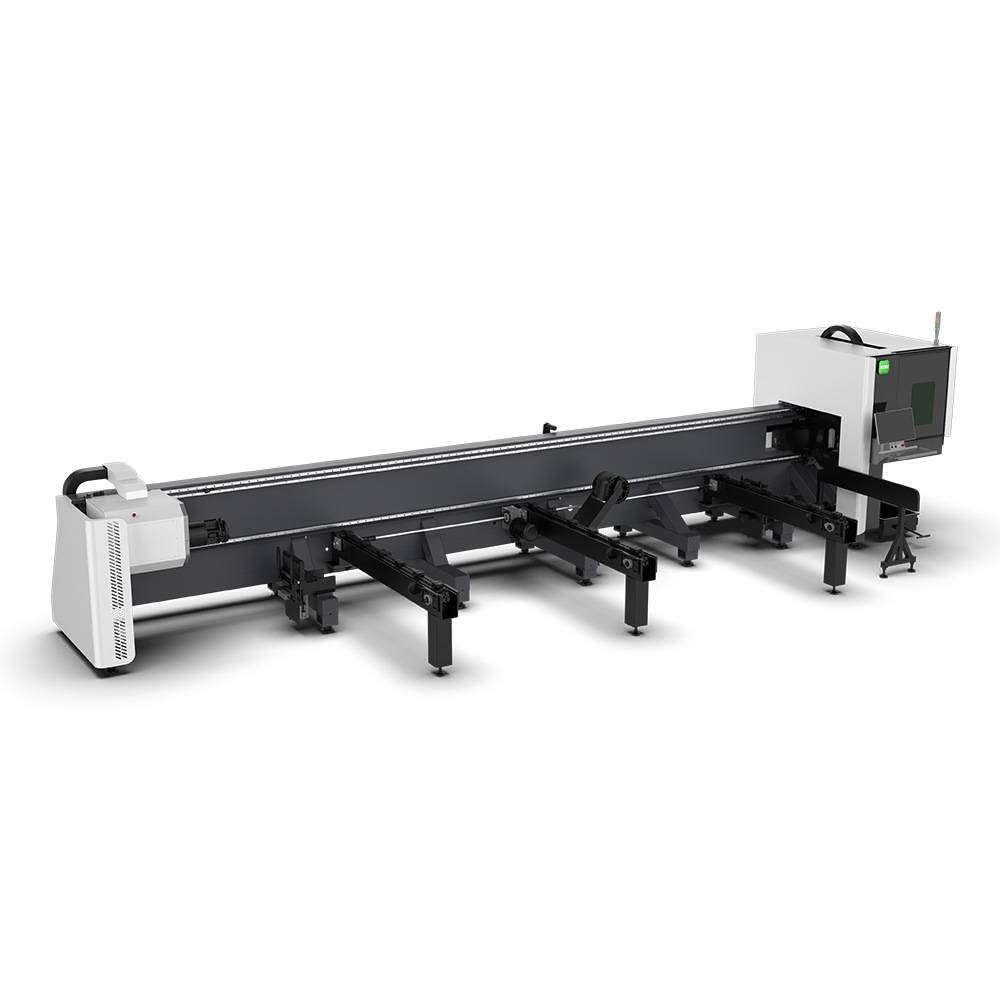
Precision in tube fabrication is often compromised by material sag and end-of-pipe waste. Advanced CNC systems now utilize a 3-chuck zero-tailing technology to solve these inefficiencies. By employing a middle chuck that acts as a bridge between the feeding and unloading zones, the system provides continuous material support throughout the cutting cycle. This configuration allows the high-speed fiber laser oscillator to process material right up to the edge of the tube, reducing tailing waste to nearly zero. For manufacturers, the ability to reclaim 50mm to 150mm of material per tube translates into significant annual savings on raw material costs.
Beyond mechanical handling, optical precision is managed through sophisticated kerf compensation algorithms embedded within the Bus CNC system. As the fiber laser resonator emits the beam, the kerf—or the width of the cut—must be accounted for to ensure dimensional accuracy of the finished part. Proper kerf management, combined with optimized focal lengths, minimizes the heat-affected zone (HAZ). A reduced HAZ is essential for maintaining the metallurgical properties of the tube, particularly in thin-walled stainless steel where excessive heat leads to warping or grain growth. By controlling the thermal input, the machine produces weld-ready edges that require zero post-processing, further reducing the total cost of production.
Material Adaptability and Resonator Efficiency
The versatility of a fiber laser resonator determines the range of contracts a facility can fulfill. Modern affordable tube lasers are equipped to handle a diverse metallurgical spectrum, from standard carbon steel to highly reflective non-ferrous alloys. When processing carbon steel, the system utilizes oxygen-assisted cutting to promote exothermic reactions, increasing cutting speeds in thicker sections. Conversely, for stainless steel and aluminum, high-pressure nitrogen is used to shield the melt pool, ensuring a clean, oxide-free finish.
Reflective materials like aluminum, brass, and copper have historically posed risks to the high-speed fiber laser oscillator due to back-reflections. However, contemporary resonators feature integrated optical isolators and advanced monitoring sensors that protect the internal components from reflected photons. To maintain stability during the processing of these materials, the machine employs a servo-driven support system. These supports dynamically adjust their height based on the tube’s rotation, preventing the material from bowing under its own weight. This ensures that the distance between the cutting nozzle and the tube surface remains constant, which is a prerequisite for maintaining a stable focal point and consistent cut quality across the entire length of the workpiece.
Automation Integration and ROI Calculations
The leap from manual tube processing to an automated tube loading system is the most significant factor in calculating the return on investment (ROI). An automated tube loading system eliminates the bottleneck of manual material handling, allowing for continuous, “lights-out” operation. These systems can stage multiple bundles of raw material, automatically measuring tube length and detecting cross-sections before feeding them into the pneumatic full-stroke chuck. This reduces the idle time between cycles from minutes to seconds.
Complementing the hardware is the role of CNC nesting optimization software. This software serves as the brain of the operation, calculating the most efficient layout of parts on a single length of tubing. By utilizing common-line cutting and bridge-cutting techniques, the software minimizes the number of piercings required, which preserves the life of the cutting nozzle and reduces gas consumption. Furthermore, the Bus CNC system provides real-time data feedback on power consumption and processing times, allowing shop managers to refine their quoting accuracy. When the efficiency gains from CNC nesting optimization are combined with the reduced labor requirements of an automated loader, the initial price of the machine is often recouped within 12 to 18 months of standard operation. This makes the investment not just a purchase of hardware, but a fundamental upgrade to the facility’s competitive capacity in a high-demand market.
Advanced Fiber Laser Tube Processing Technology
Our CNC Fiber Laser Tube Cutting systems revolutionize metal fabrication by integrating high-precision cutting, punching, and profiling into a single automated workflow. Designed for versatility, this technology handles a wide array of profiles including Round, Square, Rectangular, and Oval tubes, as well as complex L-shaped and U-shaped channels.
- Precision Punching: High-speed hole punching with micron-level accuracy, eliminating the need for mechanical drilling or die-stamping.
- Complex Profiling: Advanced 3D pathing allows for intricate interlocking joints and specialized notch cuts, ideal for structural frames.
- High Material Efficiency: Intelligent nesting software minimizes scrap, reducing raw material costs across large production runs.
- Clean Finish: Delivers oxide-free, burr-free edges that require zero secondary grinding before welding.

Seamlessly processing multiple profiles with consistent precision.
Global Delivery & Logistics



From our high-tech manufacturing facility directly to your global site. PCL WeldCut ensures secure packaging, professional handling, and reliable international logistics to safeguard your equipment throughout the entire journey.
