Technical Specifications and Operational Dynamics of 3000W Fiber Laser Tube Cutting Systems
The integration of a 3000W fiber laser resonator into industrial tube processing represents a critical threshold where high-speed throughput meets precision structural engineering. As global manufacturing shifts toward lean production, the 3000W platform has emerged as the industry standard for processing medium-to-thick walled tubing with high efficiency. This technical whitepaper analyzes the mechanical architecture, optical performance, and automation integration required to maximize ROI in modern fabrication environments.
H2 Dynamic Performance and Kinematic Stability
The operational efficiency of a tube laser is governed by its kinematic chain—specifically the synchronization between the longitudinal gantry movement and the rotational velocity of the chucks. A 3000W system utilizes a high-strength, heat-treated machine bed designed to withstand accelerations of up to 1.2G. This rigidity is essential to prevent harmonic vibrations that could compromise edge quality during high-speed directional changes.
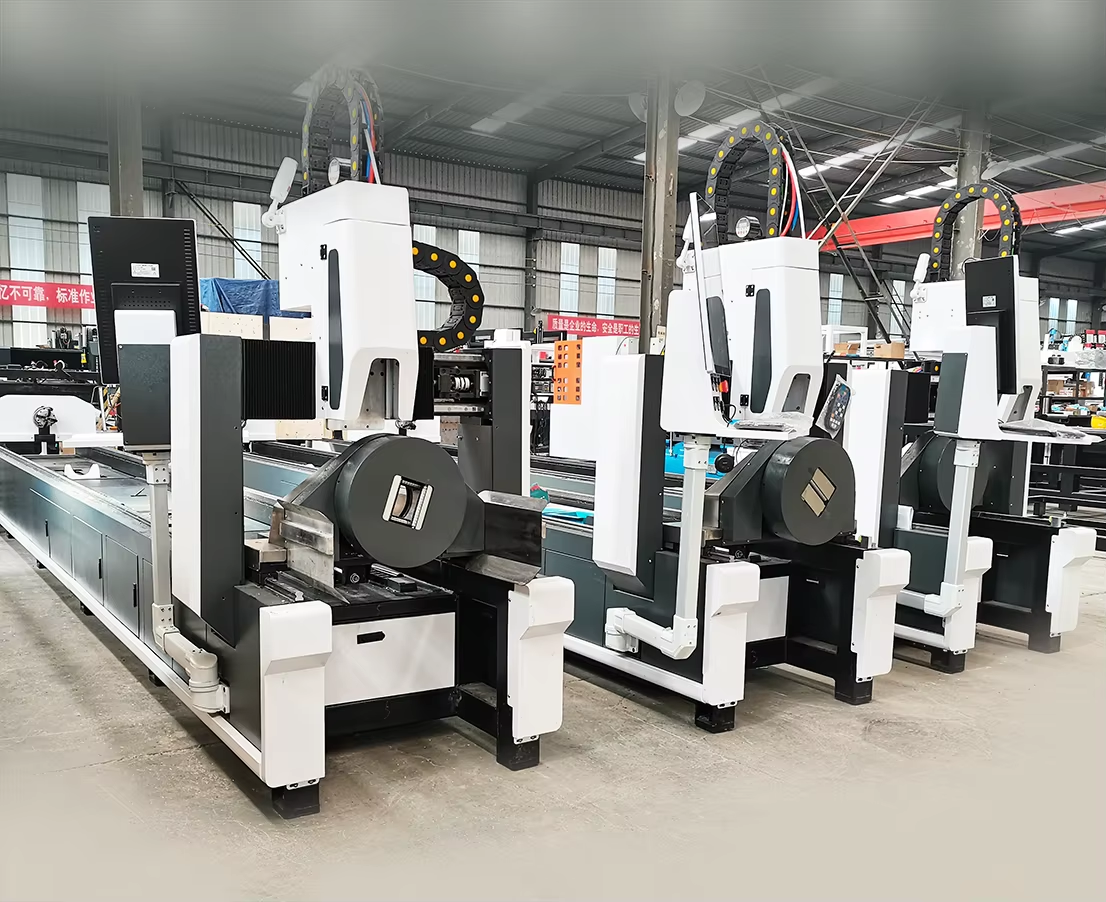
Central to this dynamic performance is the pneumatic full-stroke chuck system. Unlike manual or hydraulic variants, the pneumatic full-stroke chuck provides instantaneous clamping without the need for manual jaw adjustments across varying diameters (typically 20mm to 220mm). These chucks are capable of rotation speeds exceeding 120 RPM, allowing the bus CNC system to maintain a constant surface feed rate even on complex rectangular or elliptical profiles. To manage the centrifugal forces exerted by heavy workpieces, servo-driven support lifters are deployed along the machine bed. These supports adjust in real-time to the tube’s profile, preventing “tube whip” and ensuring the focal point remains consistent relative to the material surface.
H2 Precision Engineering and Zero-Tailing Technology
Achieving dimensional accuracy in tube cutting requires more than raw power; it demands sophisticated beam delivery and material handling. Precision engineering in these systems is often measured by the minimization of the Heat-Affected Zone (HAZ). The 3000W high-speed fiber laser oscillator produces a high-energy density beam that allows for faster travel speeds, which inherently reduces the duration of thermal exposure. This results in a narrower kerf and a microscopic HAZ, preserving the structural integrity of the base metal and reducing the need for post-process grinding.
One of the most significant advancements in precision tube processing is 3-chuck zero-tailing technology. Traditional two-chuck systems often leave a “tail” of unprocessed material ranging from 150mm to 300mm, representing significant scrap costs. A 3-chuck configuration utilizes a movable intermediate chuck that supports the tube during the final cut. This allows the cutting head to process the material between the chucks or even behind the third chuck, reducing tailing waste to nearly zero. Furthermore, advanced bus CNC systems implement real-time kerf compensation. This software-driven feature automatically adjusts the laser path to account for the width of the laser cut, ensuring that internal diameters and interlocking tabs meet tolerances within +/- 0.05mm.
H2 Material Adaptability and Oscillator Efficiency
A 3000W fiber laser resonator offers a versatile power profile capable of processing a wide spectrum of industrial alloys. In carbon steel applications, the system utilizes oxygen as a cutting gas to facilitate an exothermic reaction, allowing for the efficient processing of wall thicknesses up to 20mm. For stainless steel, high-pressure nitrogen is employed to shield the cut, resulting in a clean, oxide-free edge that is ready for immediate welding.
Processing reflective materials, such as aluminum and copper, historically presented challenges due to back-reflection damaging the optical fiber. Modern 3000W systems mitigate this through advanced isolators within the high-speed fiber laser oscillator. When cutting aluminum, the system optimizes beam frequency and pulse width to overcome the material’s high thermal conductivity. The result is a consistent dross-free finish even on 8mm to 10mm aluminum profiles. The adaptability of the 3000W power level ensures that the operator can transition from thin-walled 1mm decorative tubing to 12mm structural components without changing the hardware configuration, simply by adjusting the CNC parameters.
H2 Automation, CNC Nesting, and ROI Optimization
The transition from a manual process to an automated one is the primary driver of return on investment in tube cutting. An automated tube loading system is no longer an optional peripheral but a core component of high-volume production. These systems utilize bundle loaders that automatically measure, orient, and feed individual tubes into the chucks. By reducing the load cycle to under 15 seconds, the automated tube loading system ensures the laser resonator maintains a high “beam-on” time percentage.
Complementing the hardware is CNC nesting optimization software. This technology analyzes the production queue and arranges parts to maximize material utilization. In tube processing, this involves not only nesting parts of the same diameter but also utilizing “common line cutting” where two parts share a single cut path, further reducing gas consumption and processing time. The software also compensates for common tube defects, such as “bow” or “twist,” by using touch-probe or laser sensors to map the actual geometry of the tube before cutting commences.
By integrating these automated features with a 3000W fiber source, manufacturers can realize a significant reduction in labor costs and a dramatic increase in parts-per-hour. The synergy of high-speed kinematics, 3-chuck precision, and intelligent nesting positions the 3000W tube laser cutter as a cornerstone of modern industrial fabrication, delivering a competitive edge through technical superiority and material efficiency.
Advanced Fiber Laser Tube Processing Technology
Our CNC Fiber Laser Tube Cutting systems revolutionize metal fabrication by integrating high-precision cutting, punching, and profiling into a single automated workflow. Designed for versatility, this technology handles a wide array of profiles including Round, Square, Rectangular, and Oval tubes, as well as complex L-shaped and U-shaped channels.
- Precision Punching: High-speed hole punching with micron-level accuracy, eliminating the need for mechanical drilling or die-stamping.
- Complex Profiling: Advanced 3D pathing allows for intricate interlocking joints and specialized notch cuts, ideal for structural frames.
- High Material Efficiency: Intelligent nesting software minimizes scrap, reducing raw material costs across large production runs.
- Clean Finish: Delivers oxide-free, burr-free edges that require zero secondary grinding before welding.

Seamlessly processing multiple profiles with consistent precision.
Global Delivery & Logistics



From our high-tech manufacturing facility directly to your global site. PCL WeldCut ensures secure packaging, professional handling, and reliable international logistics to safeguard your equipment throughout the entire journey.
